Benchmarking Compositional Generalisation for Machine Learning Interatomic Potentials
Conference Talk
Overview
- Introduction: two fields, one question
- Background: how machines learn about molecules
- Motivation: where the data runs out
- GMD: a benchmark for known parts in new molecules
- Results: where and why models fail
- Takeaways and what comes next
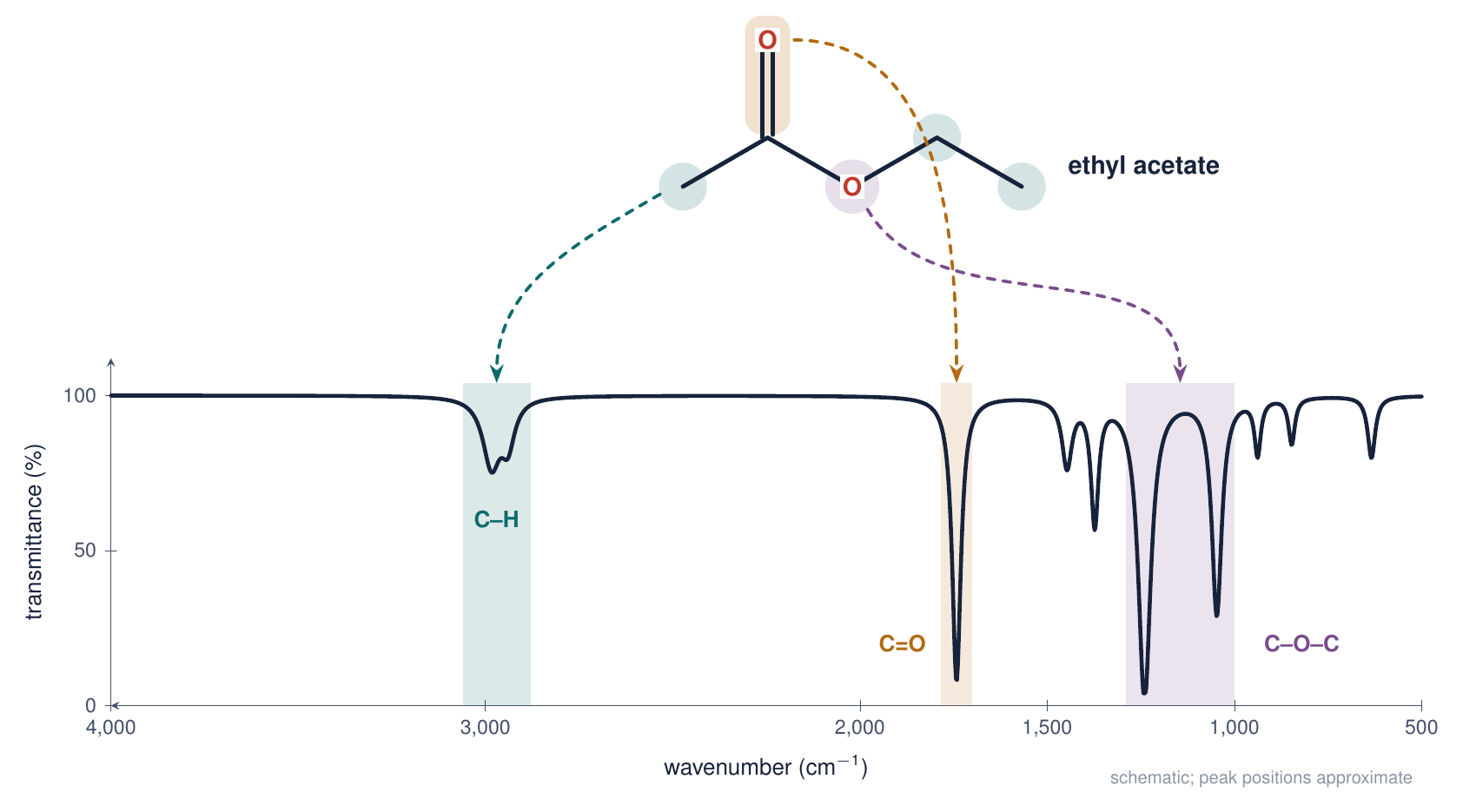
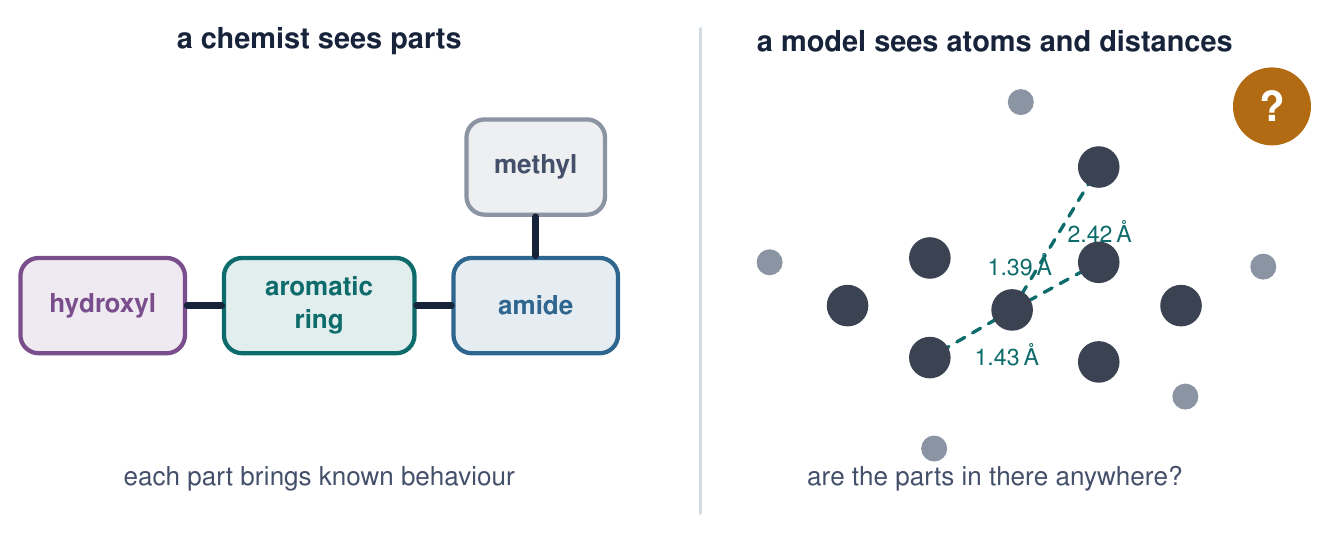
Let’s start with something every chemist does without thinking: reading a molecule.
How a chemist reads a molecule
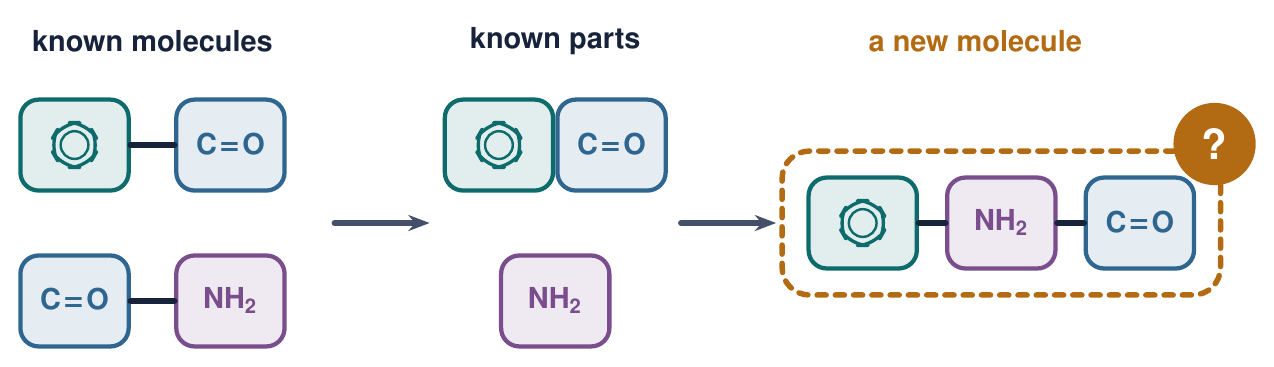
Machine learning has a name for this ability. What is it, and do models have it?
Compositional generalisation
- Learn the parts, then handle new combinations of them
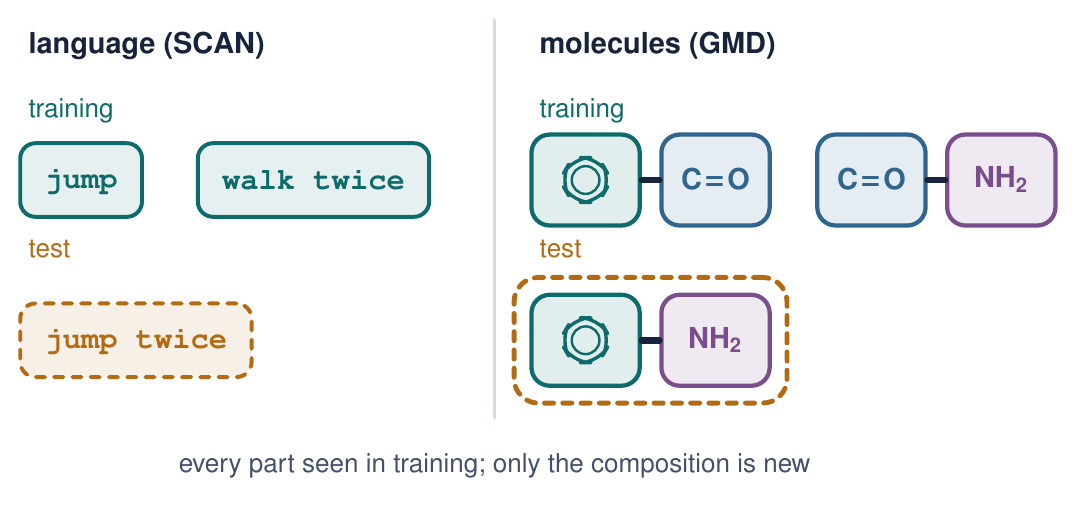
- Knowing jump and walk twice should give jump twice
- Standard models often fail: SCAN, COGS in language; CLEVR-CoGenT in vision
Chemists do this every day. For ML it is still an open problem.
Before asking whether ML models do this for molecules: how does a machine learn anything at all?
Teaching a computer from examples
- We give the computer examples: inputs and the correct answers
- It tunes a flexible formula until its predictions match those answers
- “Learning” means finding the parameters with the smallest error
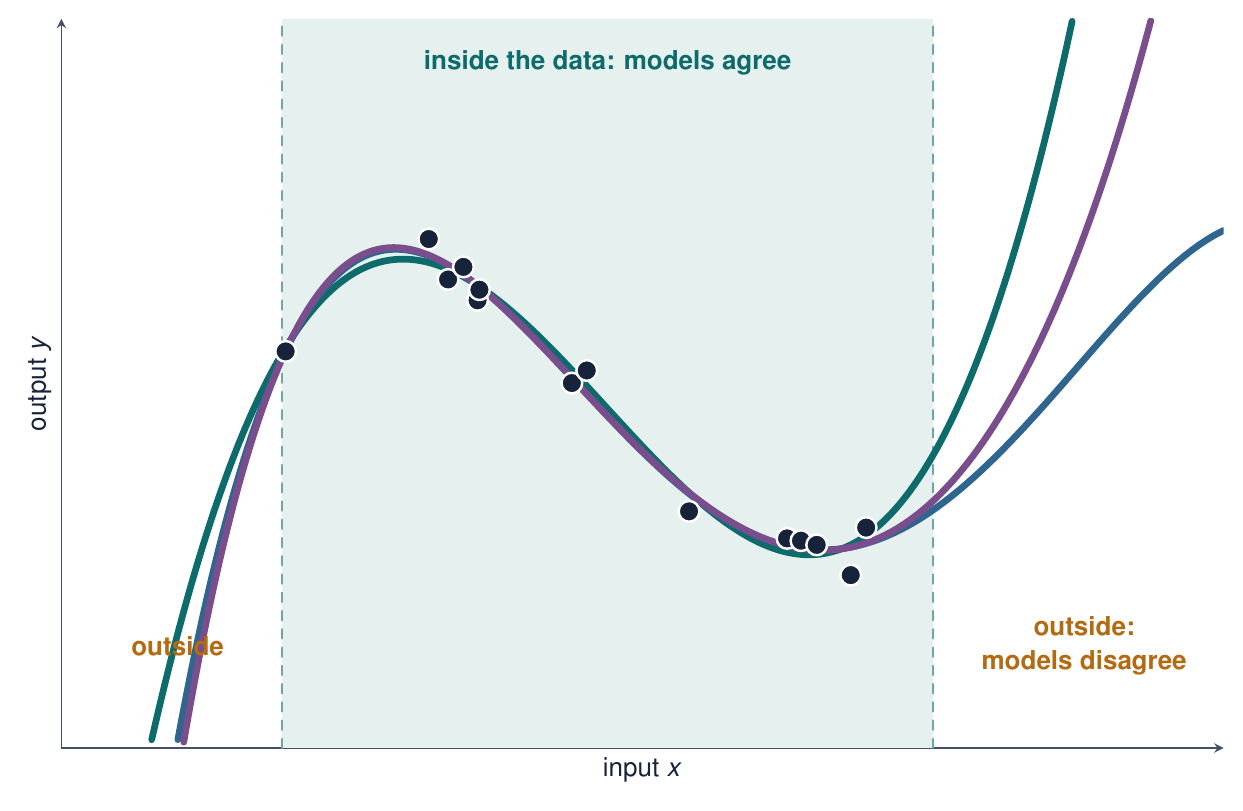
You already do this: fit a curve to two or three experimental points, then predict other amounts of reactant without running more experiments.
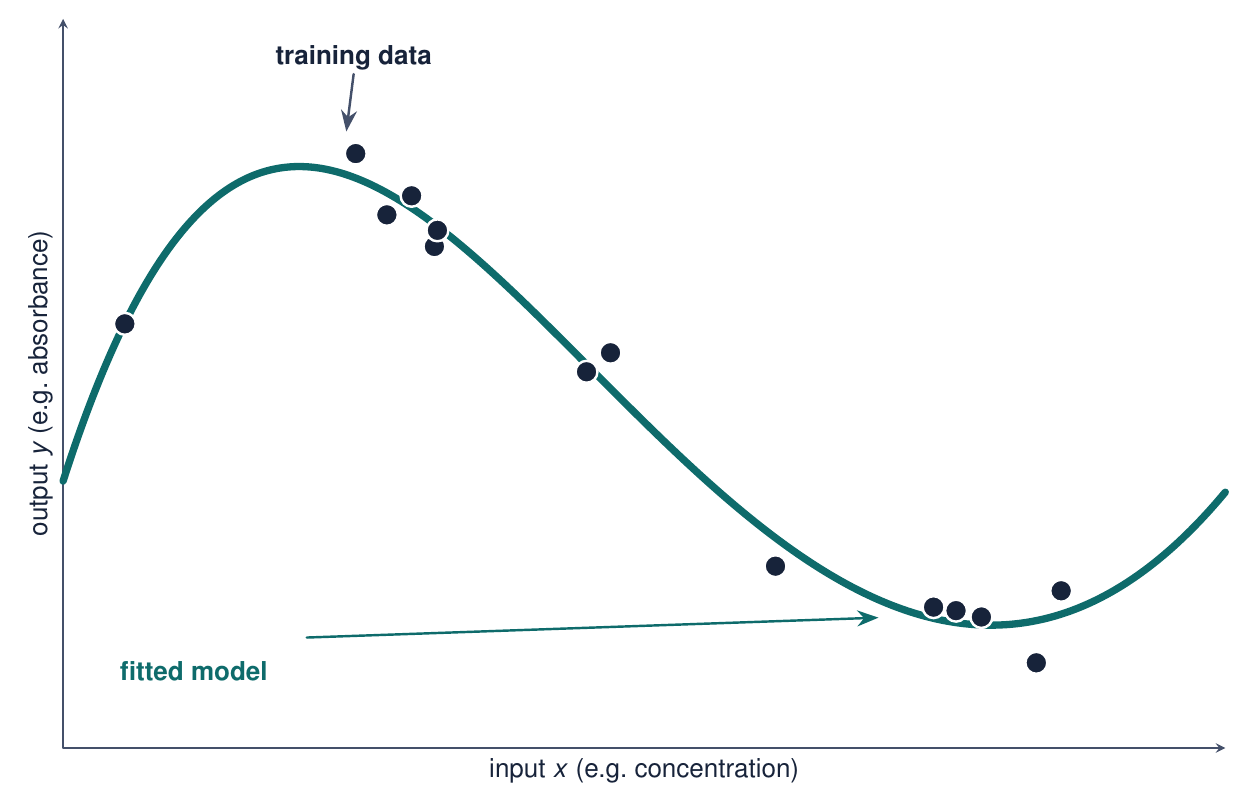
Can we trust that curve everywhere, even far from the points we measured?
Inside the data versus outside it
- Between known points the model interpolates, and is usually reliable
- Beyond them it extrapolates, and nothing in the training checks it
- Models that agree inside the data can disagree wildly outside it
A small training error says little about data the model has never seen.
Let’s see how different our interpretation of a molecule is from a computer’s.
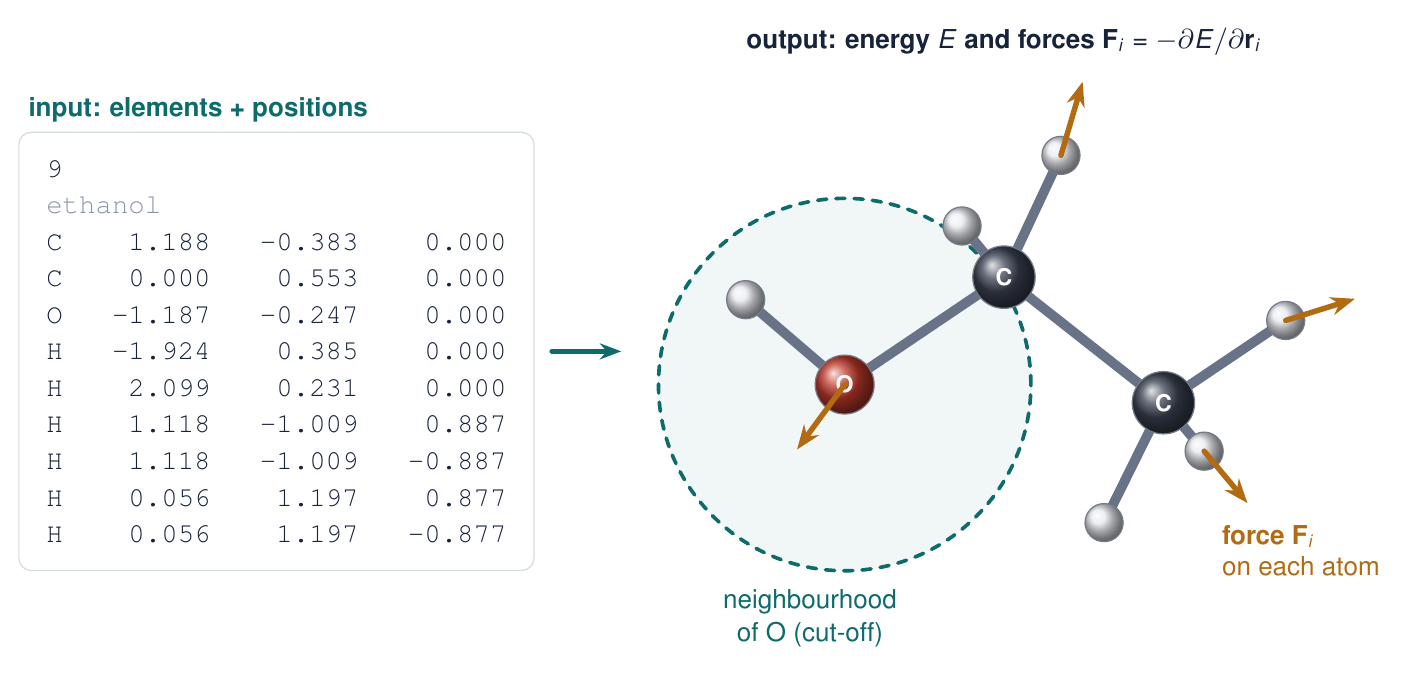
What does a molecule look like to a computer?
- Input: each atom’s element and 3D position, exactly what an
.xyzfile holds - Output: the energy E, and the force on every atom
- There are many ways to give a molecule to a computer: 3D coordinates, adjacency matrices, molecular graphs, SMILES strings, fingerprints
The model never sees a label like “carbonyl”: only elements and distances.
Then does machine learning read molecules the way a chemist does?
Does machine learning read molecules this way?
- The model learns from whole molecules, one geometry at a time
- Nothing forces it to learn “parts” the way a chemist does
- It might learn rules, or it might memorise the molecules it was shown
If every part of a new molecule is familiar, does the model find the whole familiar?
Where to get these data, and how?
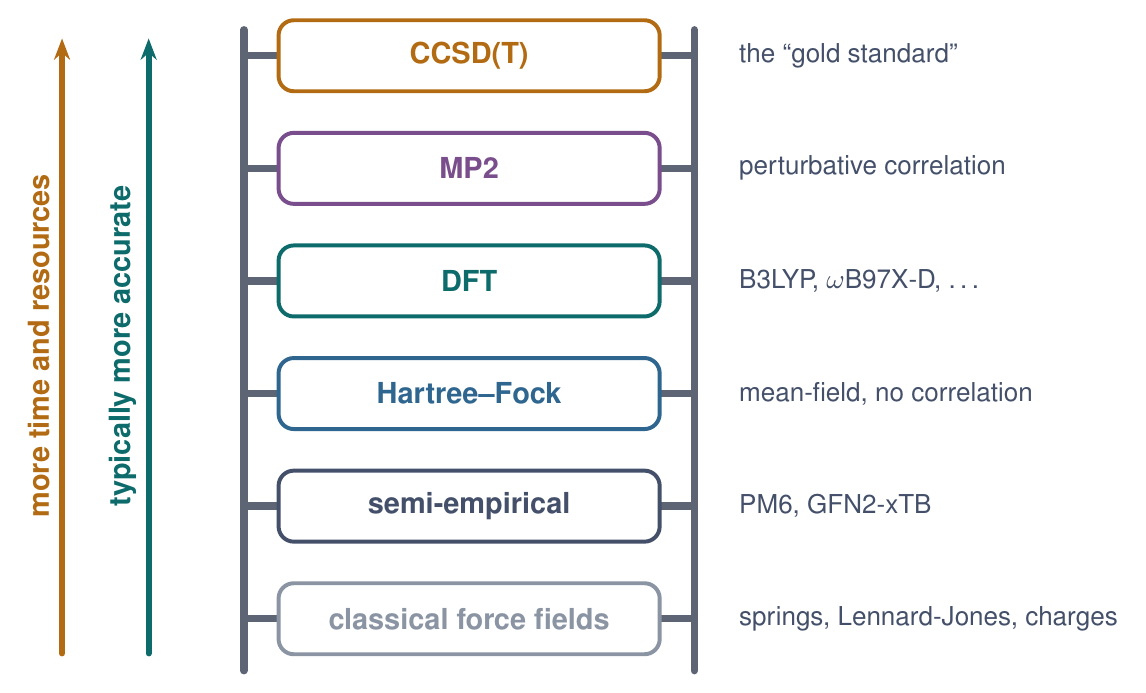
Any method can supply the data and become a teacher
- From CCSD(T) to GFN2-xTB, every method gives energies and forces for a geometry
- So any of them can supply training data
- Datasets range from ten small molecules (MD17) to over 100 million calculations (OMol25)
A model is at best as accurate as the method that produced its data.
If these methods already give us energies and forces, why not just keep using them?
Why we invented semi-empirical methods
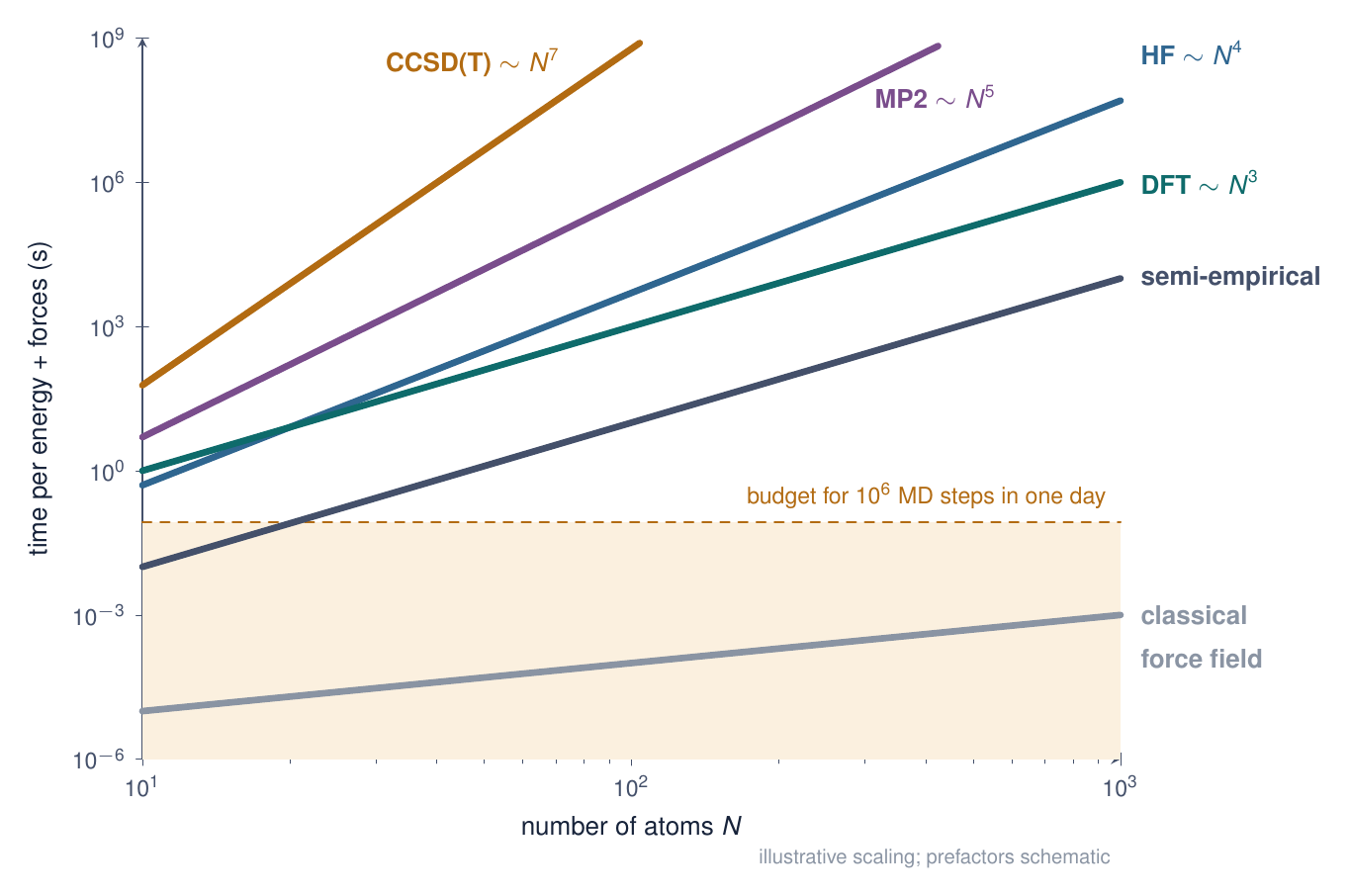
- Cost grows steeply with size: roughly N4 for Hartree–Fock, N5 for MP2, N7 for CCSD(T)
- Molecular dynamics needs energies and forces at millions of time steps
- Semi-empirical methods replaced expensive integrals with fitted parameters
Every step down the ladder makes the same trade: accuracy for time and computer resources.
Machine learning makes a similar trade, by fitting to data. So what kind of method is it?
Enter machine-learning potentials
- Learn from reference calculations once
- Then predict energies and forces in milliseconds, close to the reference accuracy
- Nanosecond MD at near-reference accuracy becomes routine
Is machine learning a numerical, a semi-empirical, or an empirical method?
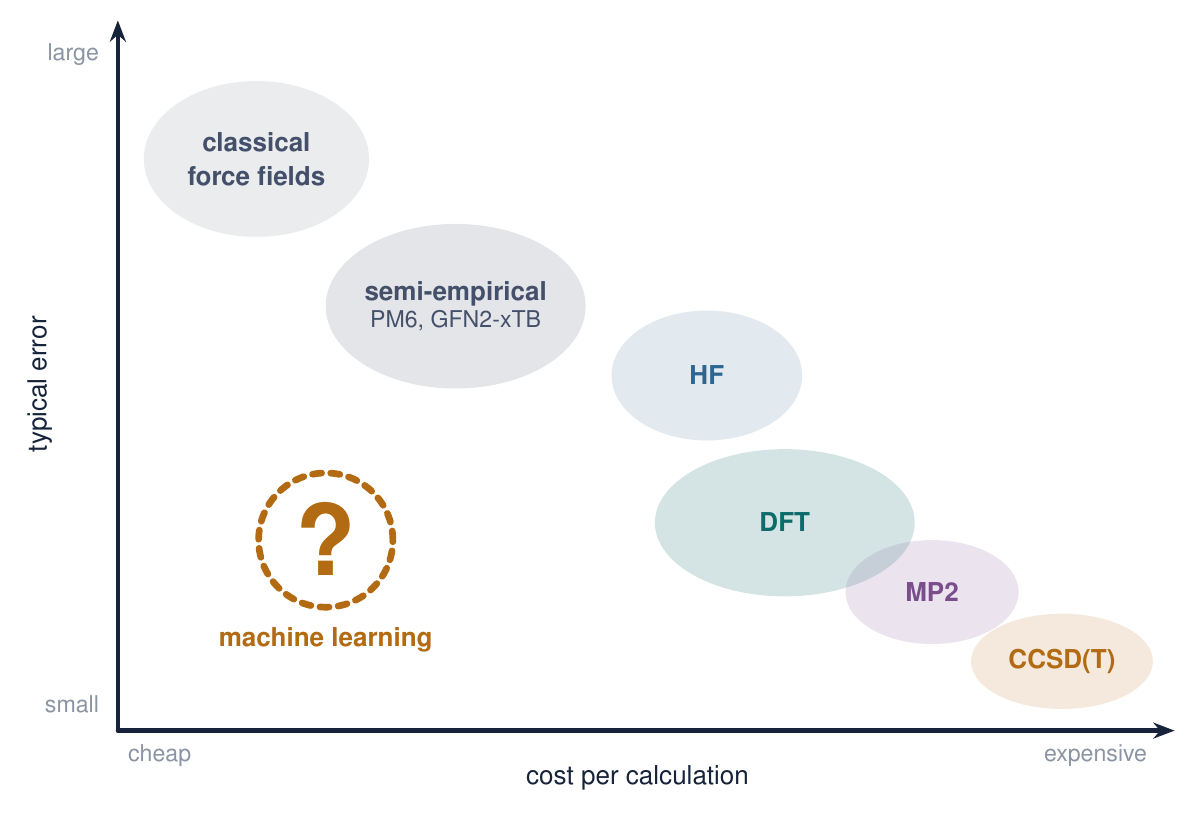
Whatever it is, it learns from data. If labels are this expensive, why not pay once, at scale, for all of chemistry?
Foundation models for atoms
- More DFT calculations, bigger datasets: MPtrj (materials), OMol25 (molecules, 100M+ calculations)
- Pre-train once on millions of structures, then fine-tune or use zero-shot
- Examples: MACE-MP-0, UMA, PET-MAD
The assumption: they learn chemistry itself. Or do they stay grounded in what they have seen?
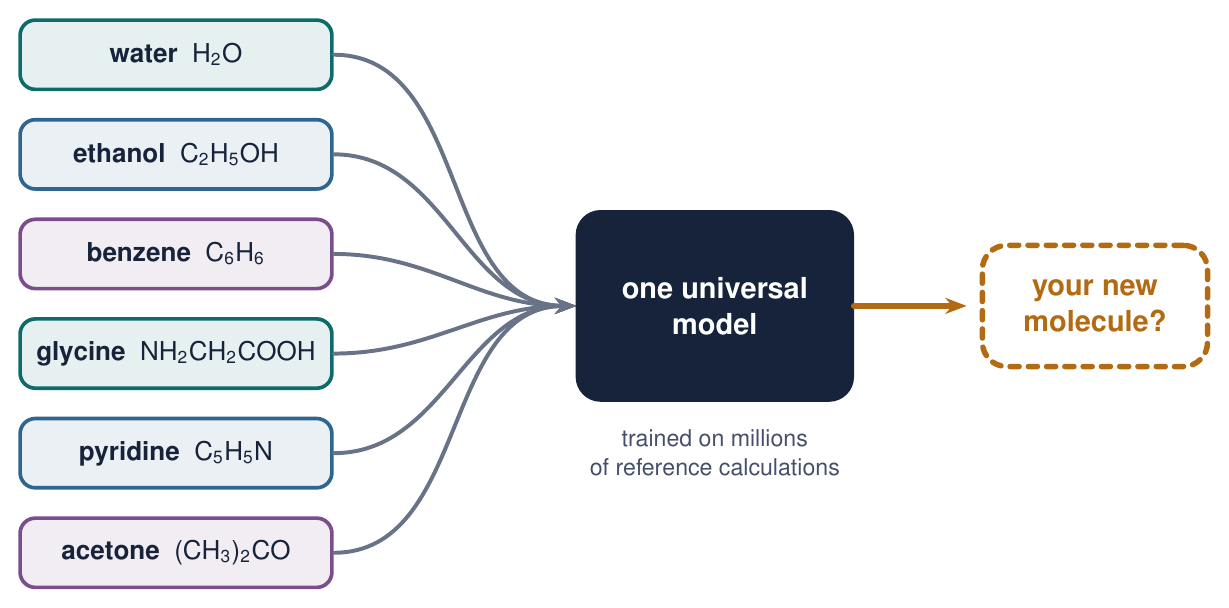
Even with millions of structures, what happens where the data runs out?
What the data covers
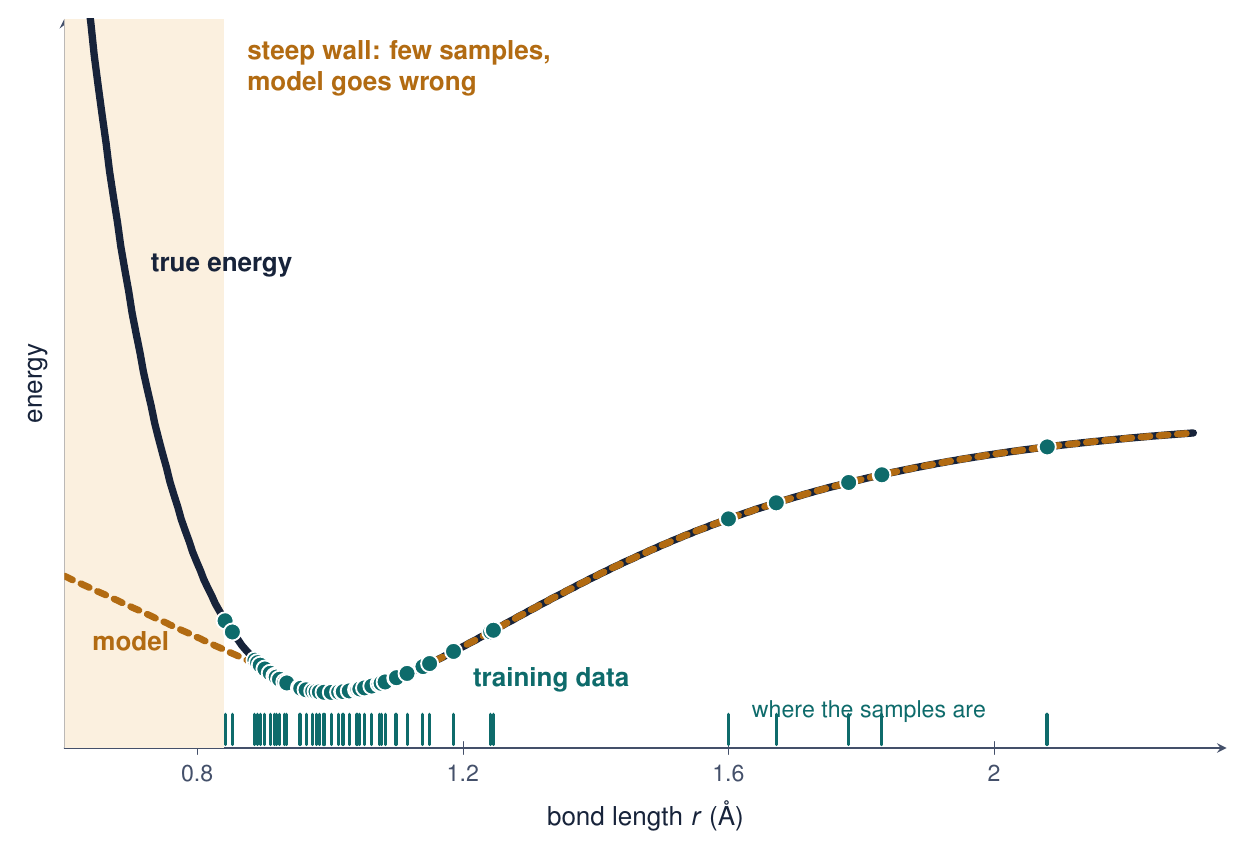
- A model is only checked where its training data are
- Room-temperature MD samples the energy well densely, and the steep repulsive wall almost never
- On the wall the model has to guess, and it guesses wrong
High-energy geometries the data does not cover: one kind of out-of-distribution.
Now think of a reaction. Which point on the path does MD visit least?
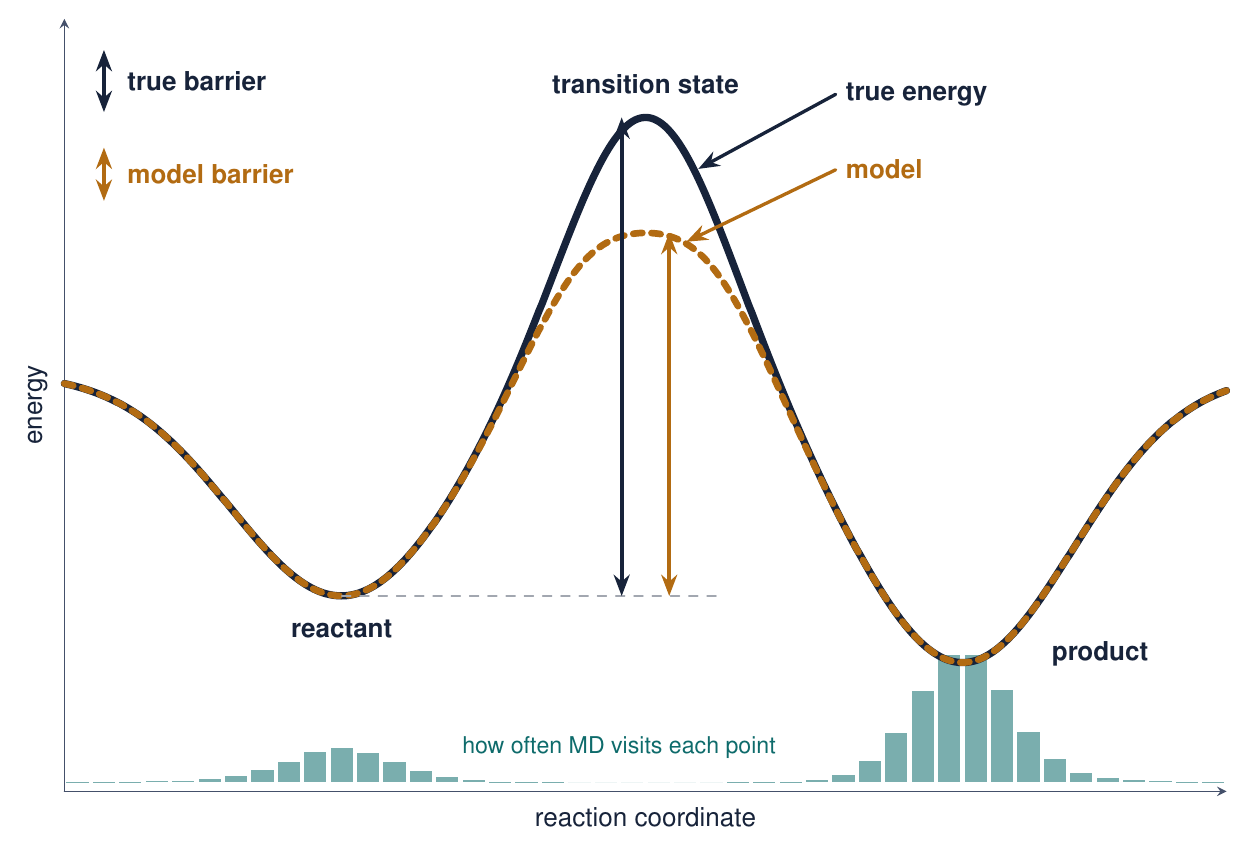
Reactions: the rarest point matters most
- MD spends almost all its time in the reactant and product wells
- The transition state is visited rarely, so it is barely in the data
- At 298 K, every 1.4 kcal/mol of barrier error is a factor of 10 in the rate
Rare events the data barely covers: a second kind of out-of-distribution.
Steep walls, rare events… what else counts as out-of-distribution?
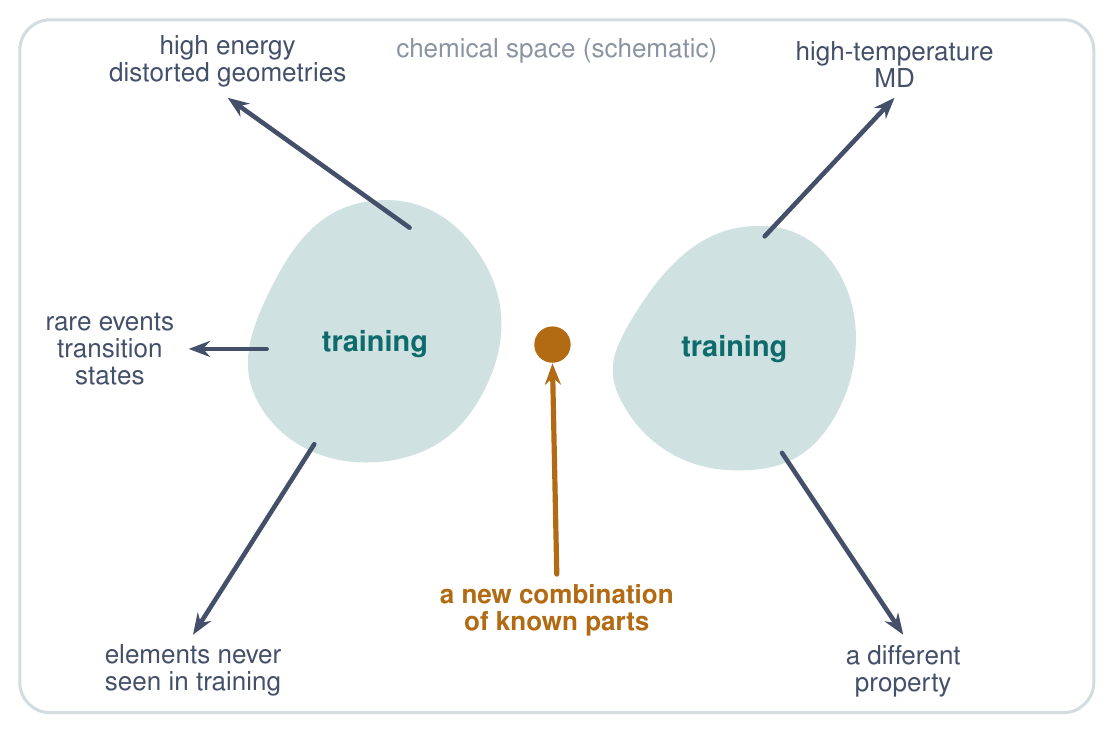
Many ways to be out-of-distribution
Out-of-distribution: anything the training data does not represent, where the model has to go beyond its data rather than fill in between it.
- High-energy geometries; rare events
- Higher temperature than in training
- Elements, charges or spin states never seen
- Solvent or surfaces, when trained in vacuum
- A new combination of known groups
Which of these do we actually test when we evaluate ML potentials today?
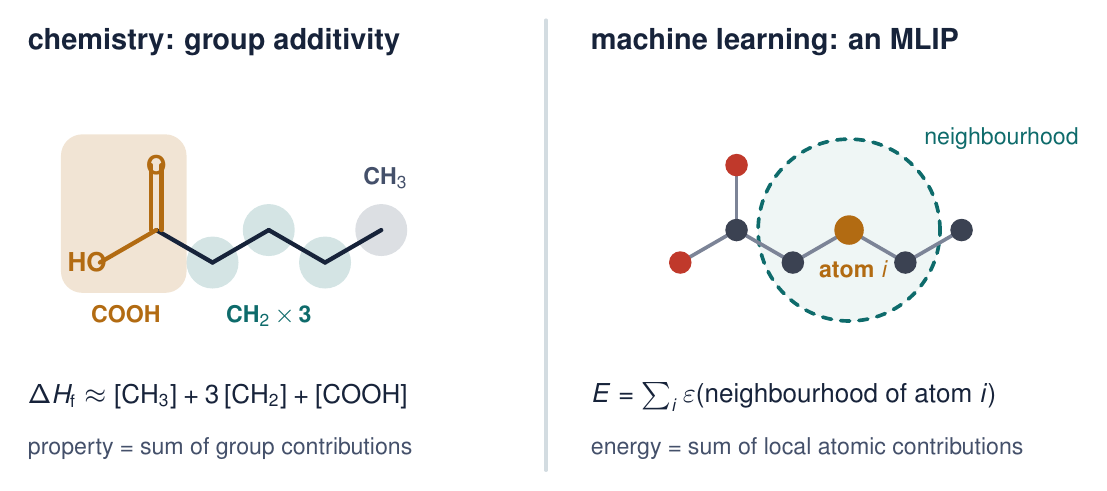
Locality: where chemistry and ML agree
- Chemistry: a property is roughly a sum of group contributions
- ML potential: the energy is a sum of contributions from each atom’s neighbourhood
- Both say the whole is built from local parts
So compositional generalisation should come for free. Does it?
How would we test that cleanly?
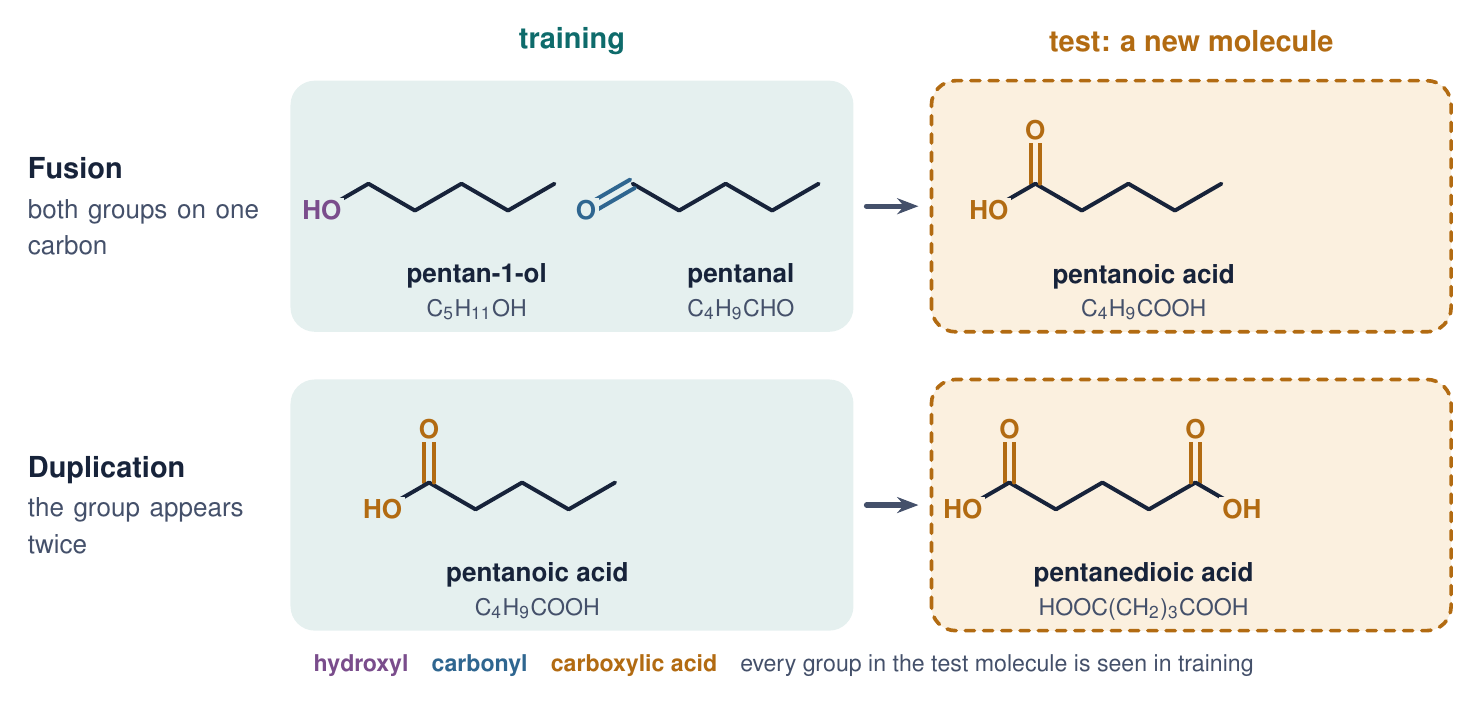
Our choice: scaffold out-of-distribution
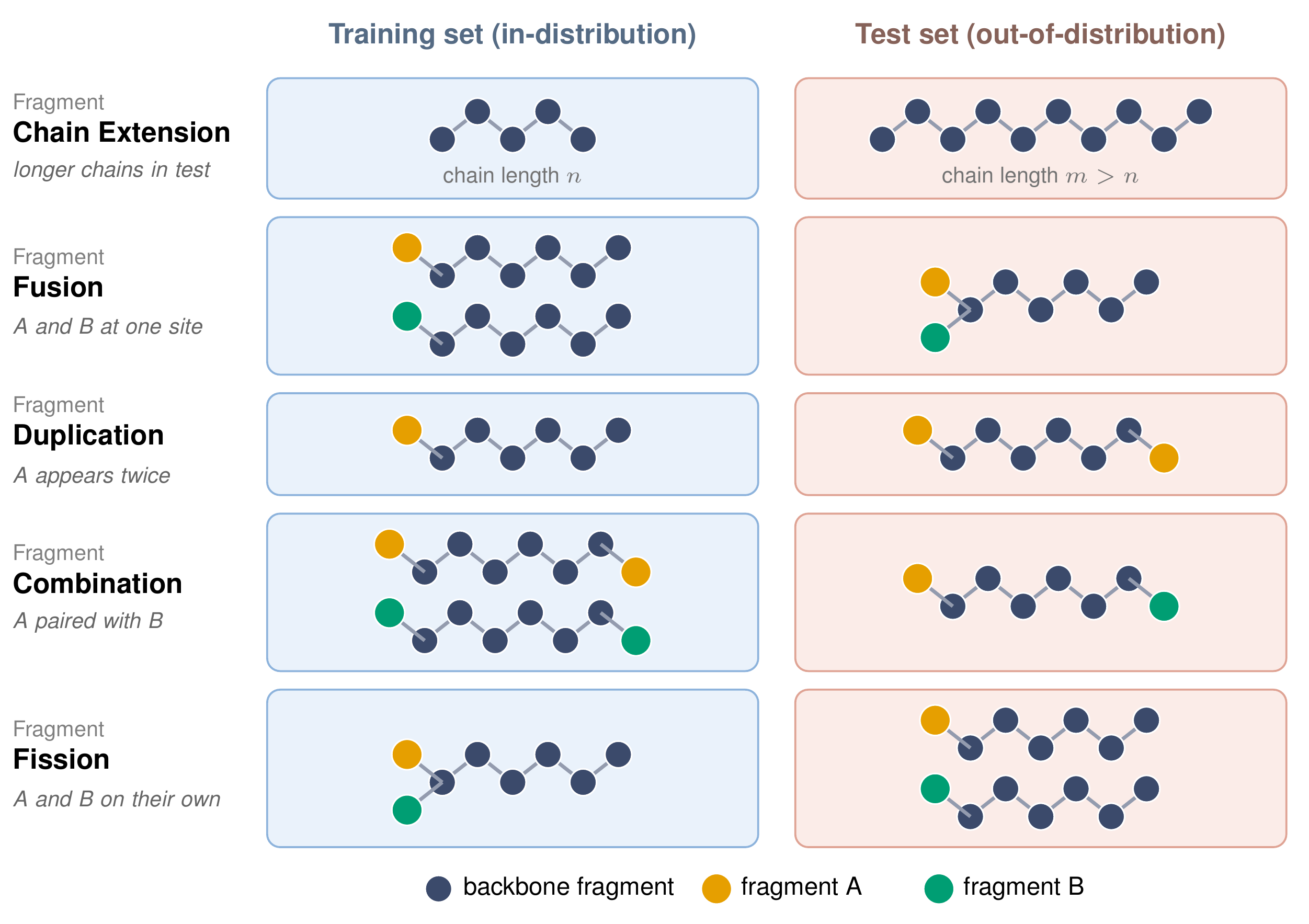
- Fusion: –OH and C=O seen apart; tested together on one carbon, as –COOH
- Duplication: one –COOH seen; tested with two
Every group is in training; only the molecule is new.
To run this test properly, we need a dataset built for it. That is GMD.
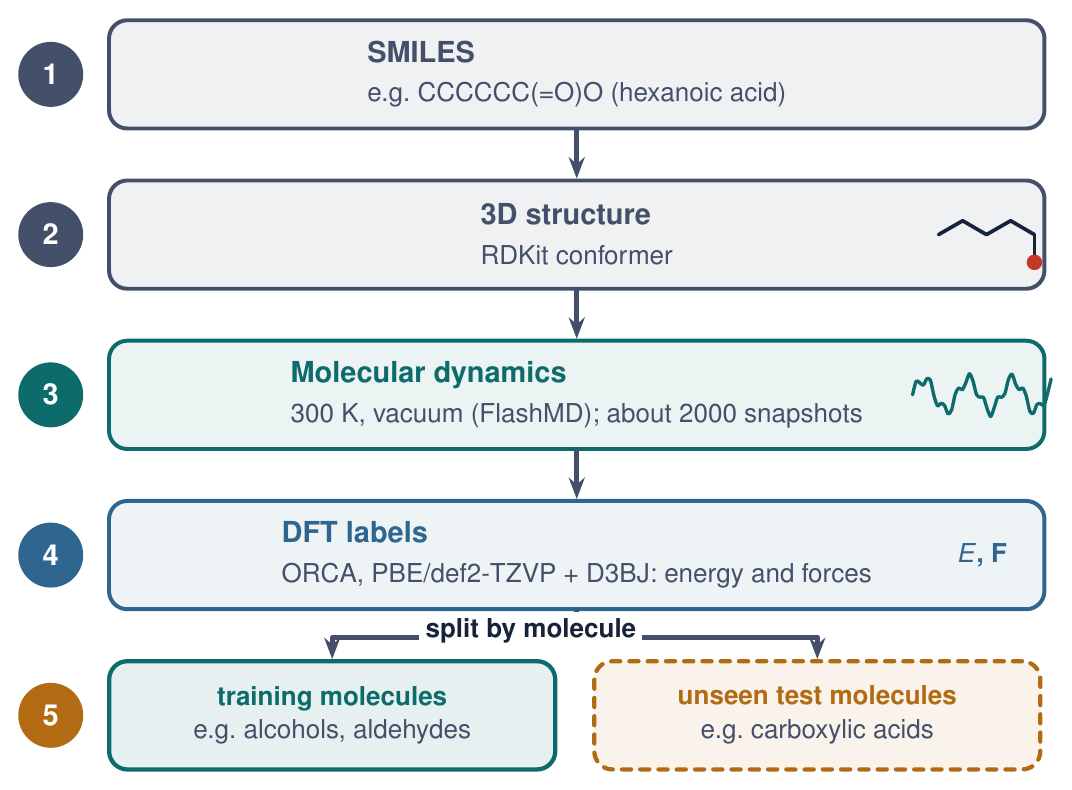
GMD: Generalisation for Molecular Dynamics
- 140 molecules in 12 families, built from H, C, N and O
- 300 K MD for each molecule, DFT energies and forces for every snapshot: about 280,000 configurations
- Splits are by molecule, never by snapshot
Models are usually tested on new shapes of known molecules. GMD tests them on new molecules.
“New molecule” can mean many things. Which kinds of novelty do we test?
Five ways to build a new molecule from known parts
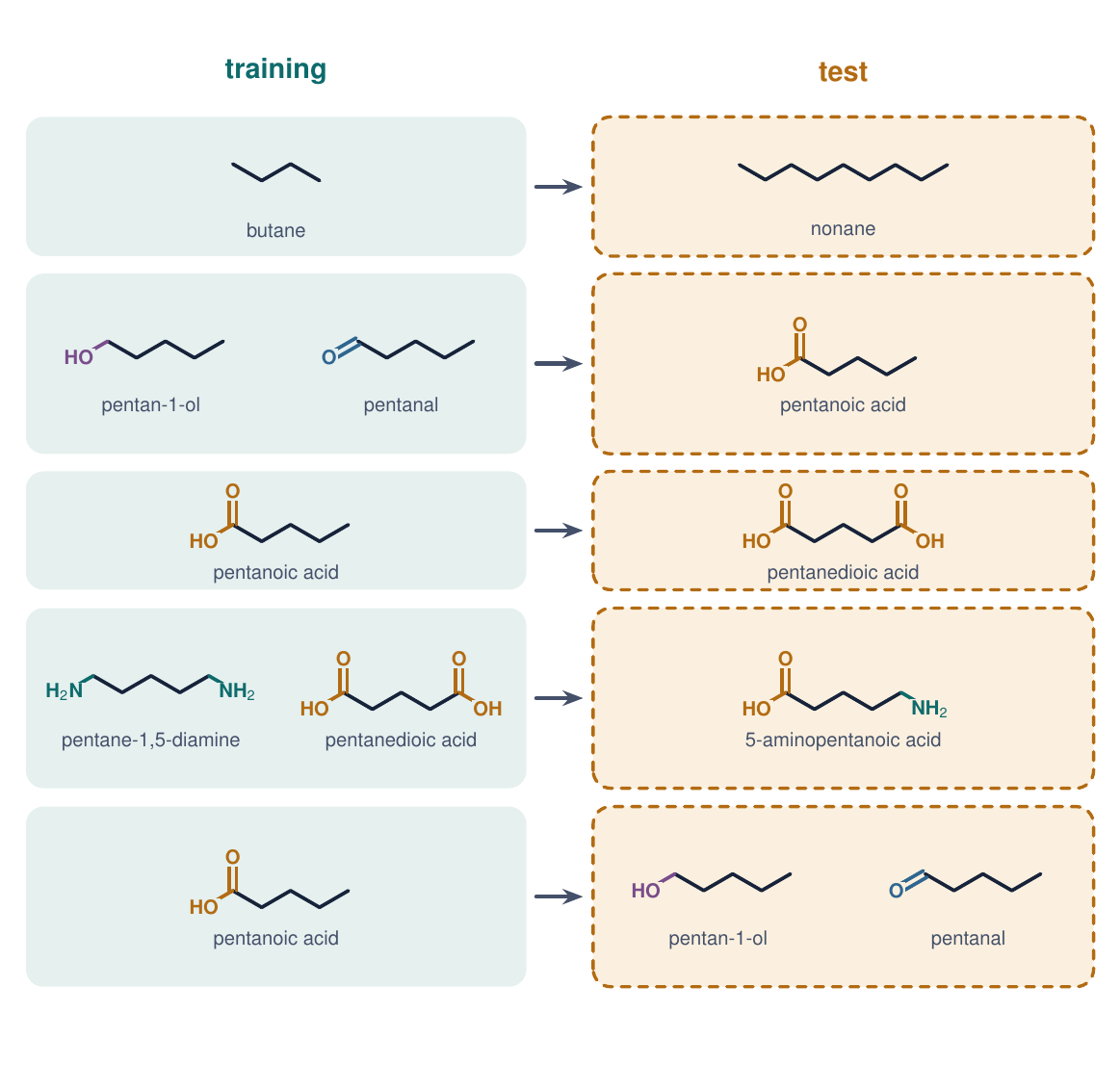
But if a model fails, is it because it never saw enough, or because it cannot compose?
The augmented variants
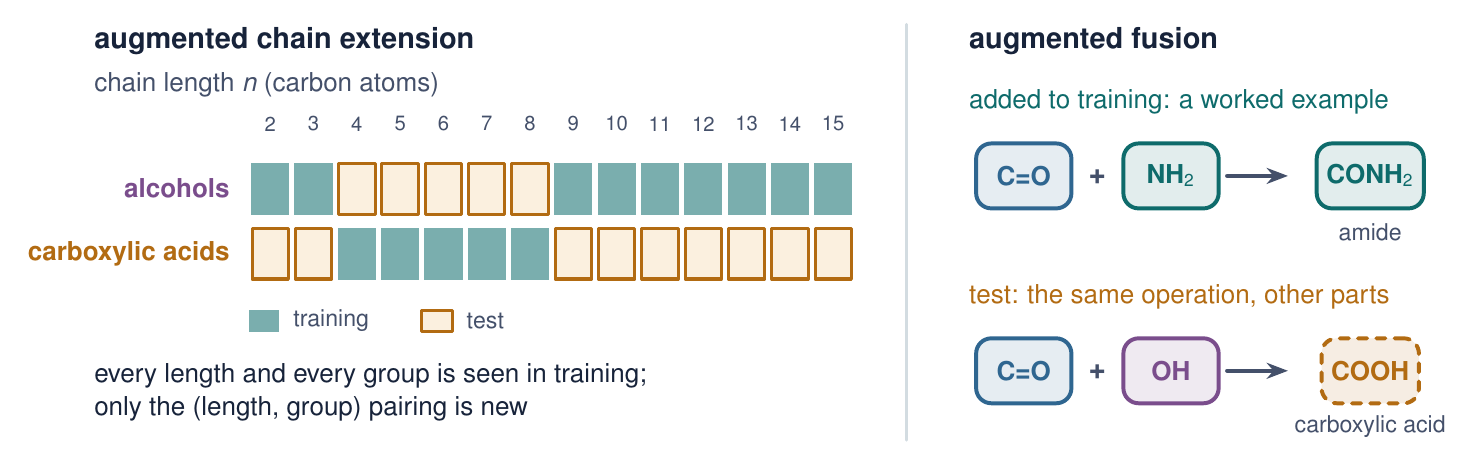
Chain extension gets the missing coverage; fusion gets a worked example of composition.
Which models do we put through all of this?
Known molecules versus new molecules
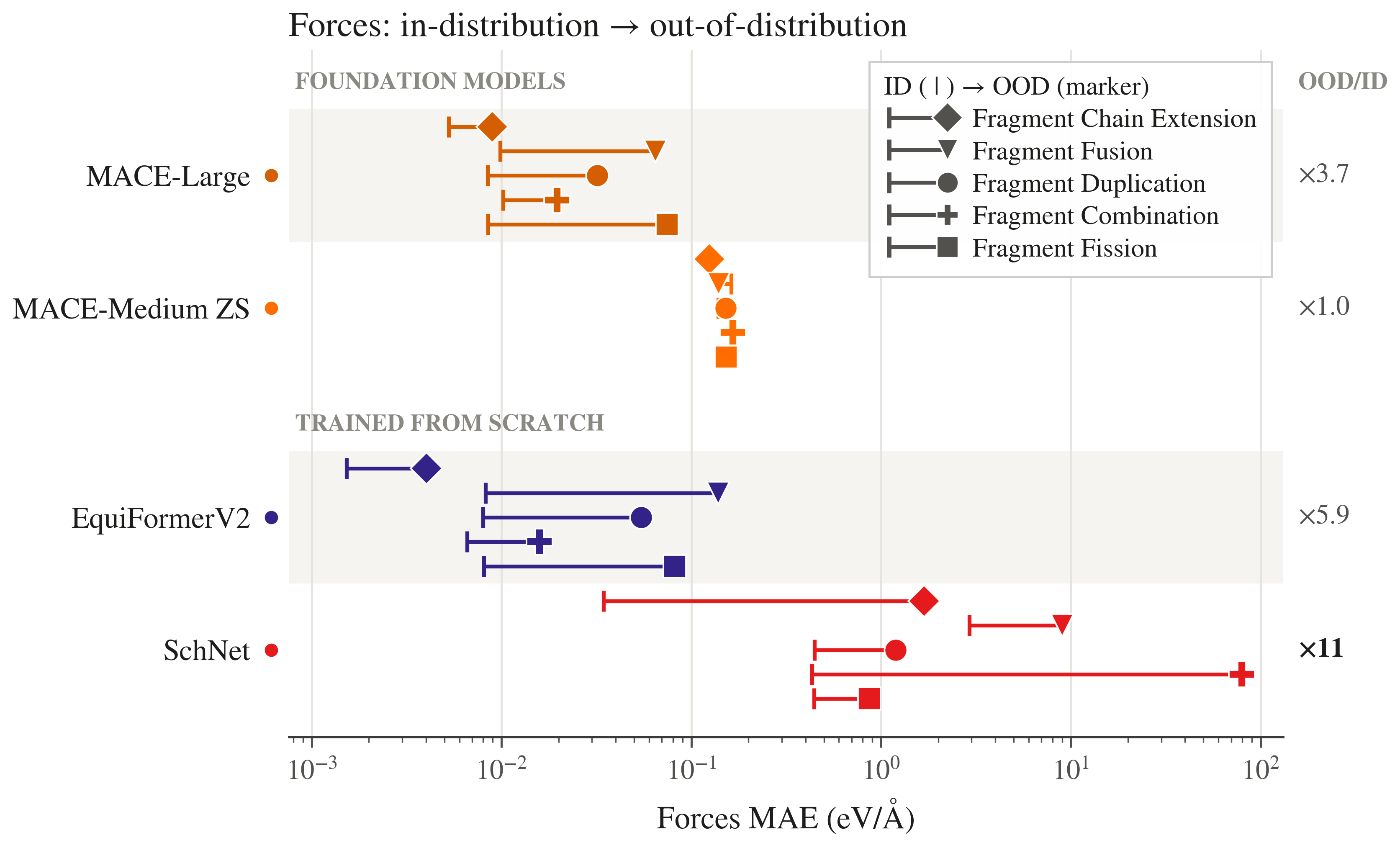
Where inside the molecule does the error appear?
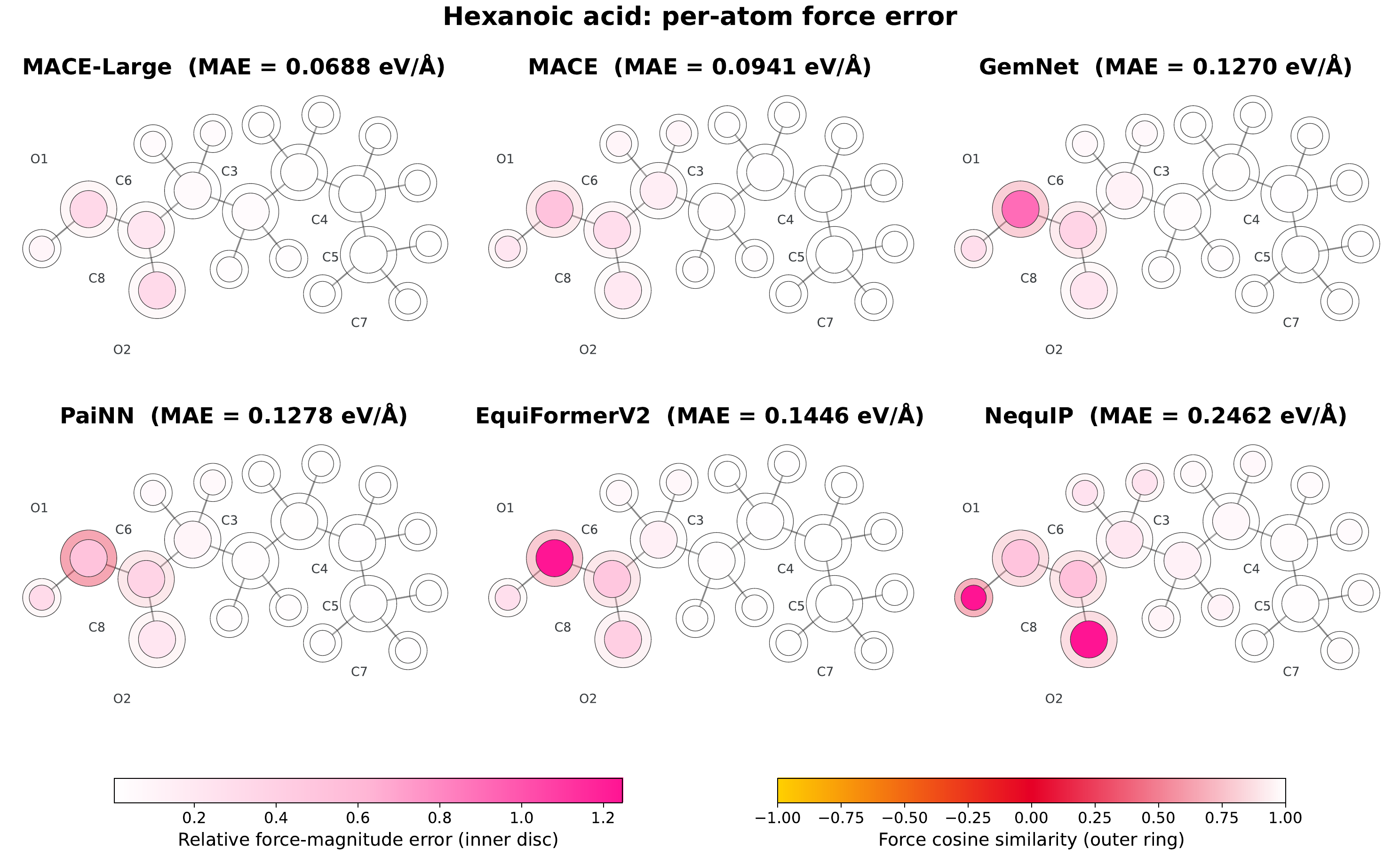
Where the failure happens: inside the molecule
- Hexanoic acid: new in the fusion task
- Inner disc: error in force strength; ring: error in direction
- Backbone fine; error on –COOH, mostly strength
Known: –OH and C=O. Not composed: –COOH.
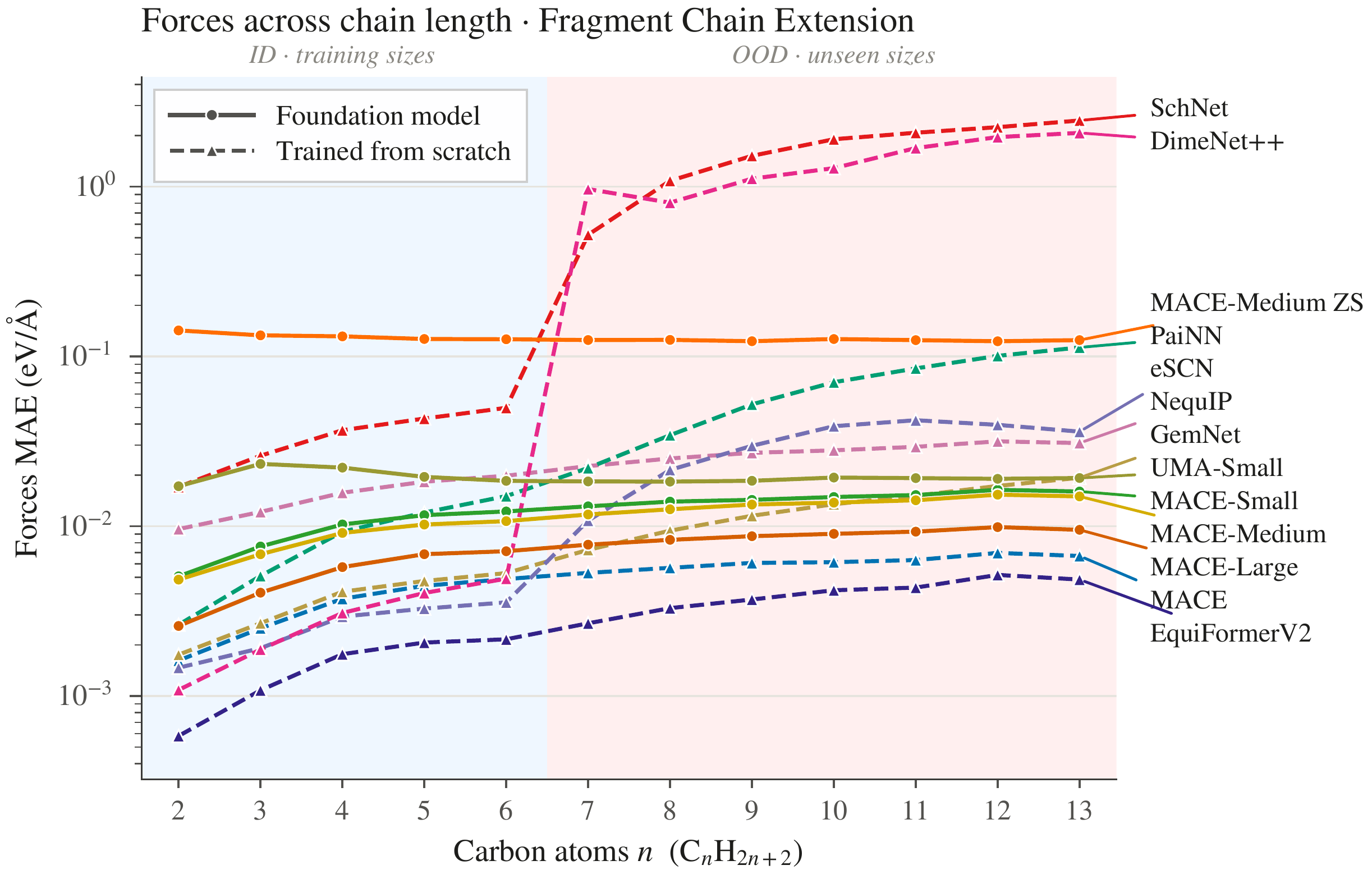
Combining parts fails badly. How does the simplest task, a longer chain, compare?
Chain extension: a smaller drop
- Train on ethane to hexane; test on heptane to tridecane
- Errors still rise with length, but far less than in the other four tasks
- SchNet and DimeNet++ break down past the training lengths
Repeating a known part costs some accuracy. Combining parts in a new way costs far more.
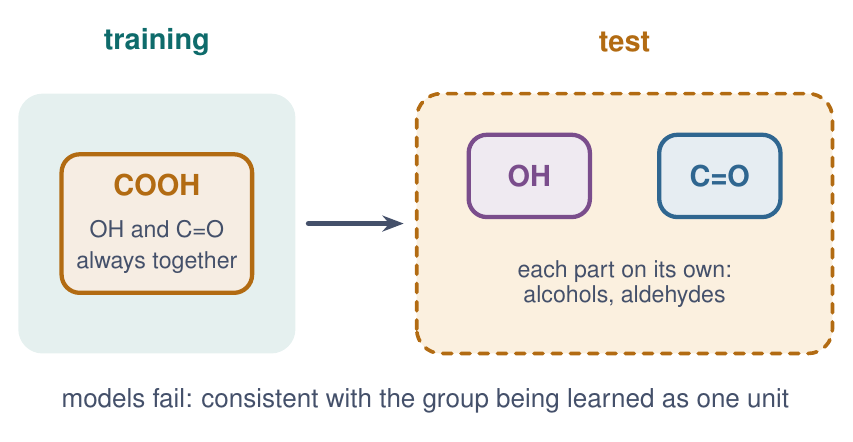
So is the problem coverage, or composition? The augmented variants answer that.
Fission: the group is learned as one unit
- Trained on carboxylic acids: –OH and C=O only ever appear together
- Tested on alcohols and aldehydes: each part alone
- The models cannot recover the parts
Consistent with –COOH being learned as one unit, not built up from its parts.
Could bigger models, pre-training or a different level of theory close the gap?
Thank you
Amir Masoud Nourollah
Paper: arXiv:2605.08988 (NeurIPS 2026)
Data: huggingface.co/datasets/AmirMasoud/GMD
Code: github.com/Nourollah/GMD-26
Questions?
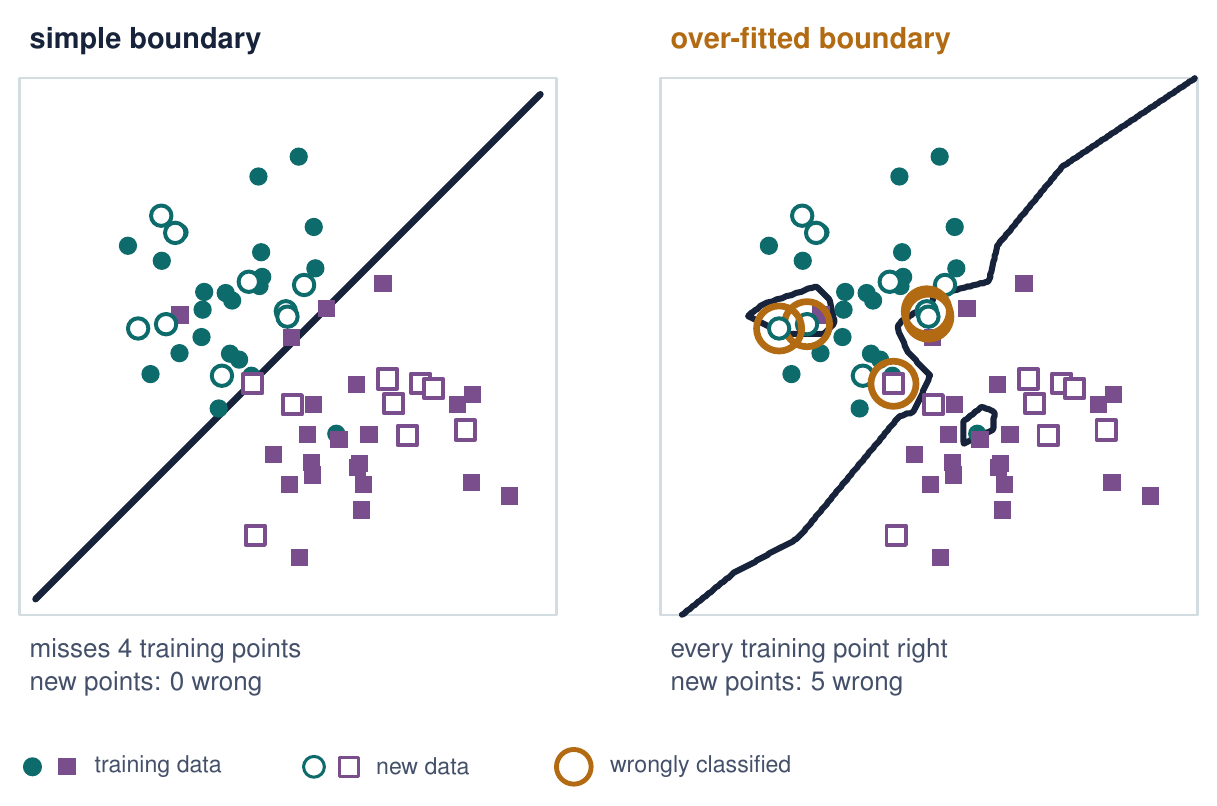
Fitting well is not generalising well
- Two kinds of points: the model learns a border between them
- A straight line misses a few training points, but gets new points right
- A wiggly border gets every training point right, and new points wrong
The goal is accuracy on data the model has never seen: generalisation.
What about points that land outside everything the model has seen, or outside what our data covers?