Knowing the parts, missing the whole: does machine learning understand new molecules built from what it already knows?
Knowing the parts, missing the whole
Overview
- Introduction: compositional generalisation, and why molecules are a clean test for it
- Motivation: how ML potentials are tested today, and what is missing
- GMD: the benchmark: known parts, new molecules
- Results: 13 models, five tasks, one failure mode
- Takeaways and what comes next
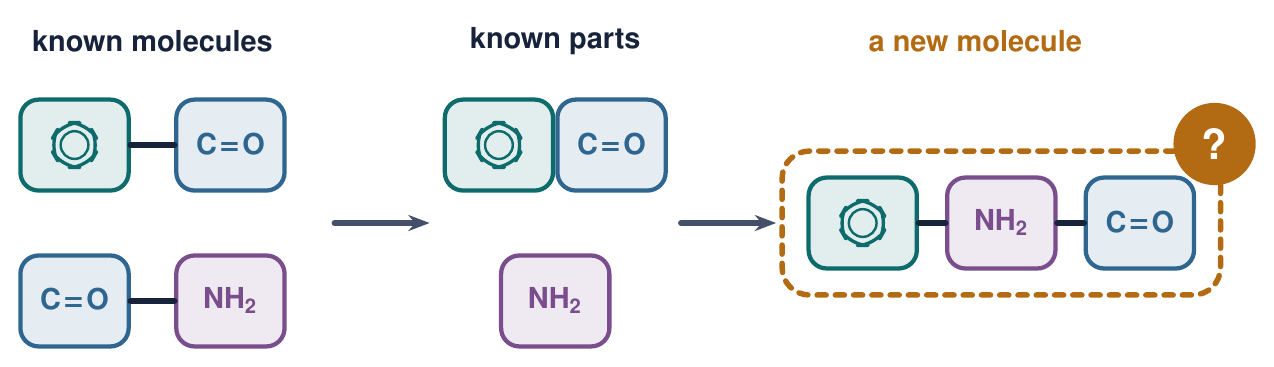
Let’s start with a question ML has asked for years: can models recombine what they know?
Compositional generalisation
- Train on the parts, test on new combinations of them
- A model that knows jump and walk twice should handle jump twice
- Standard models often fail: SCAN and COGS in language, CLEVR-CoGenT in vision
Most of these tests use synthetic tasks, where “correct” is defined by a grammar we wrote.
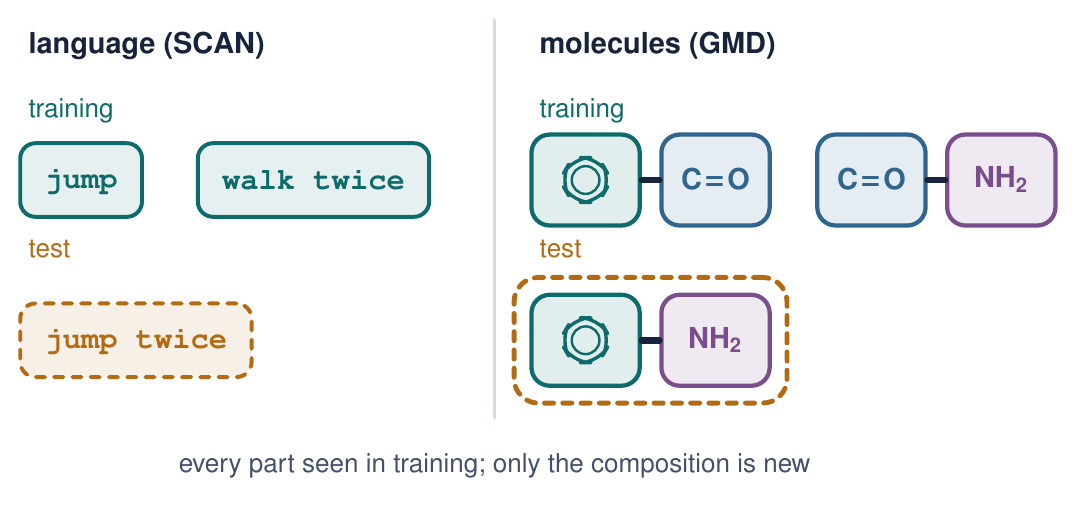
Is there a domain that is compositional by nature, with ground truth given by physics?
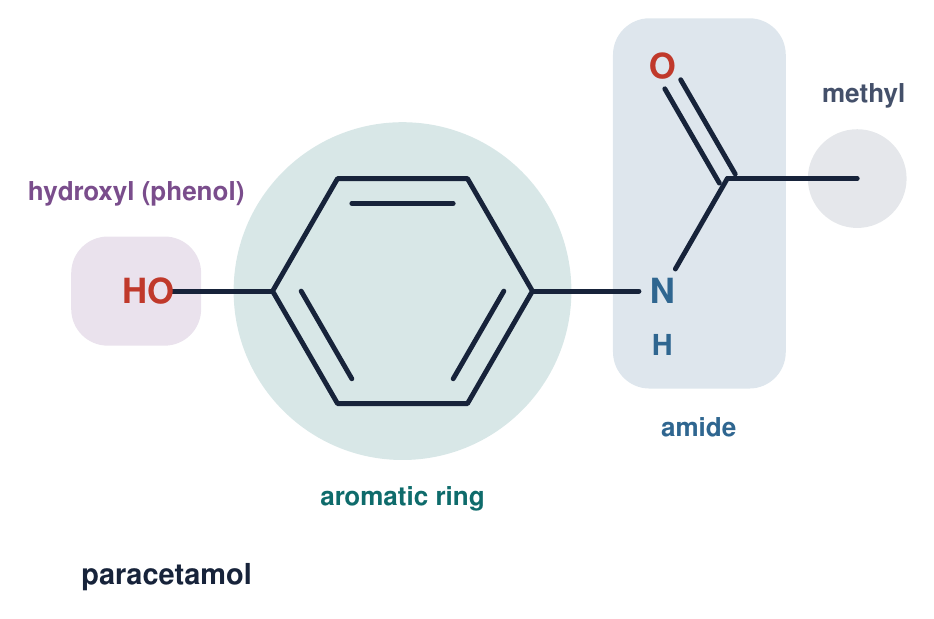
Molecules are compositional by construction
- Chemists read a molecule as parts: functional groups, rings, chains
- Parts carry their behaviour with them, which is why chemists can reason about molecules they have never met
- And the “correct answer” is not a rule we invented: it is quantum mechanics
Molecules are a natural testbed for compositional generalisation, with physically exact labels.
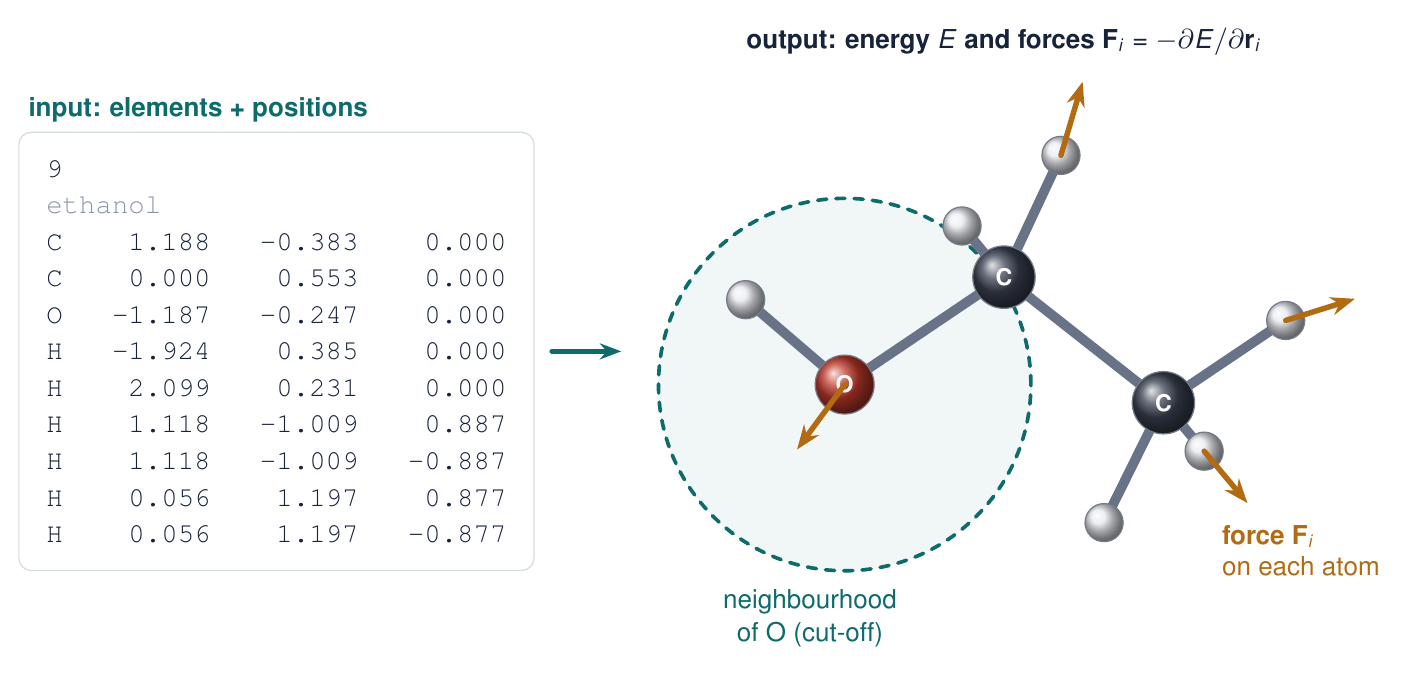
So what does an ML model actually learn about a molecule?
Machine-learning interatomic potentials
- Input: element and 3D position of every atom
- Output: energy E and forces Fi = −∂E/∂ri
- Each atom sees a local neighbourhood; E is a sum over atoms
- Mostly equivariant GNNs: NequIP, MACE, EquiFormerV2
The architecture is built from local parts, so compositional generalisation looks like it should come for free.
But why learn energies at all, instead of computing them?
Labels are expensive
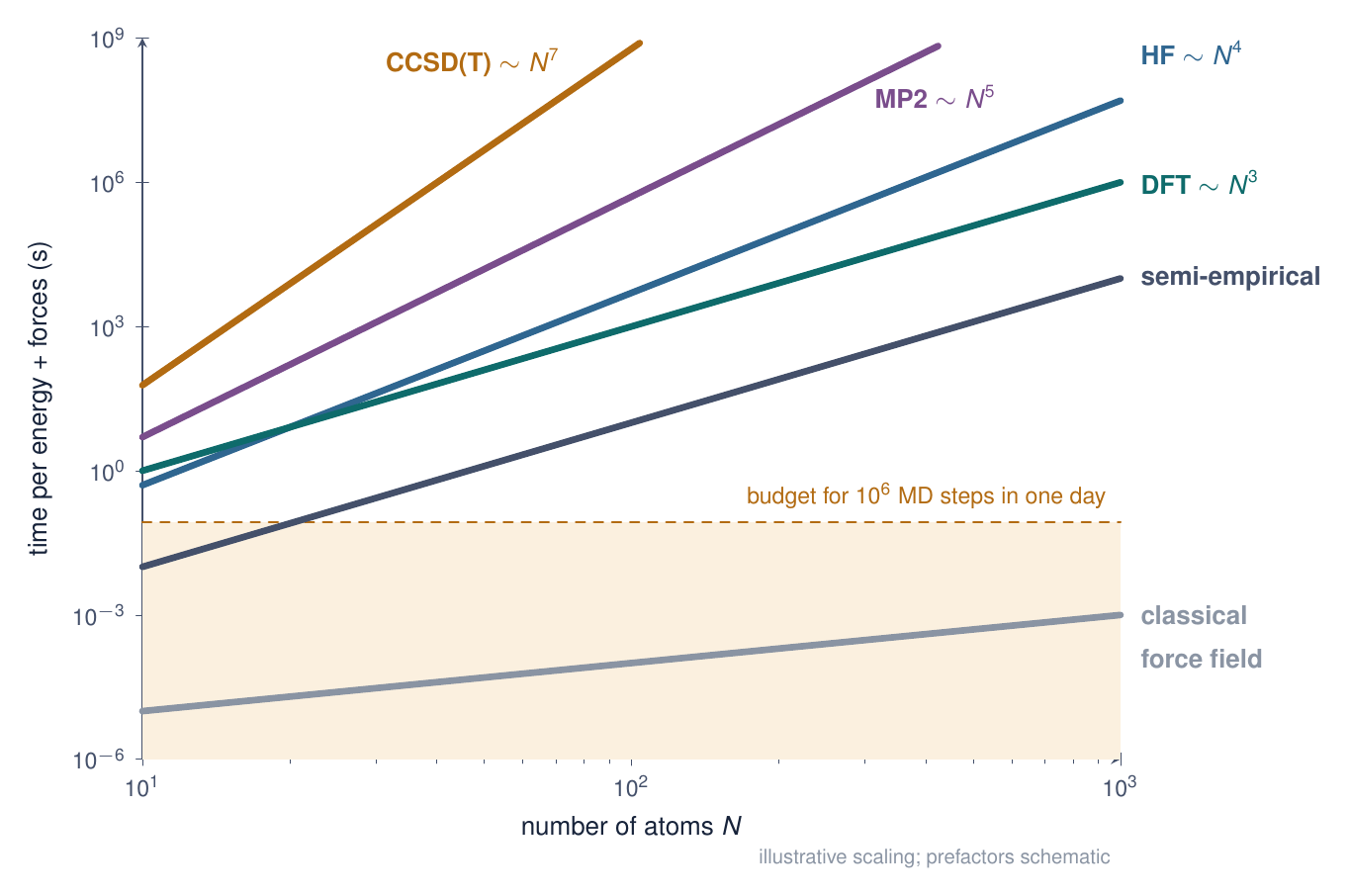
- Reference labels come from quantum chemistry: DFT scales roughly as N3, coupled cluster as N7
- Molecular dynamics needs 106 or more energy and force evaluations
- An MLIP pays the DFT cost once, at training time, then runs close to the speed of a classical force field
MLIPs amortise quantum chemistry. Their value depends entirely on how far they transfer.
If labels are this expensive, why not pay once, at scale, for all of chemistry?
Foundation models for atoms
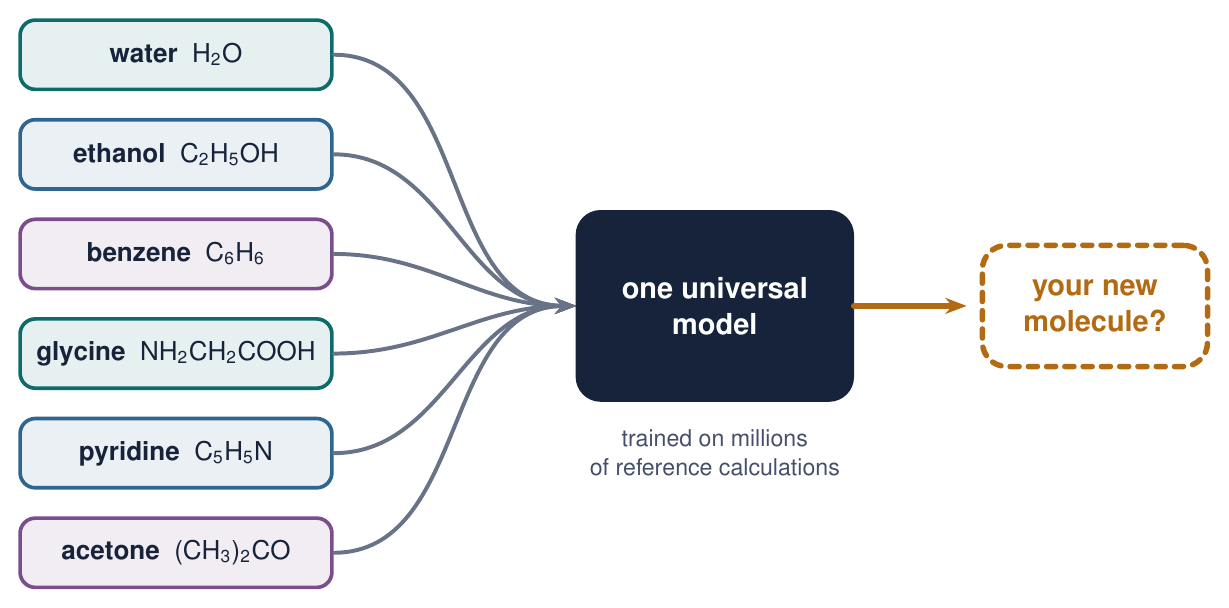
- More DFT calculations, bigger datasets: MPtrj (materials), OMol25 (molecules, 100M+ calculations)
- Pre-train once on millions of structures, then fine-tune or use zero-shot
- Examples: MACE-MP-0, UMA, PET-MAD
The assumption: they learn chemistry itself. Or do they stay grounded in what they have seen?
So how is out-of-distribution performance tested for these models today?
How MLIPs are tested out-of-distribution
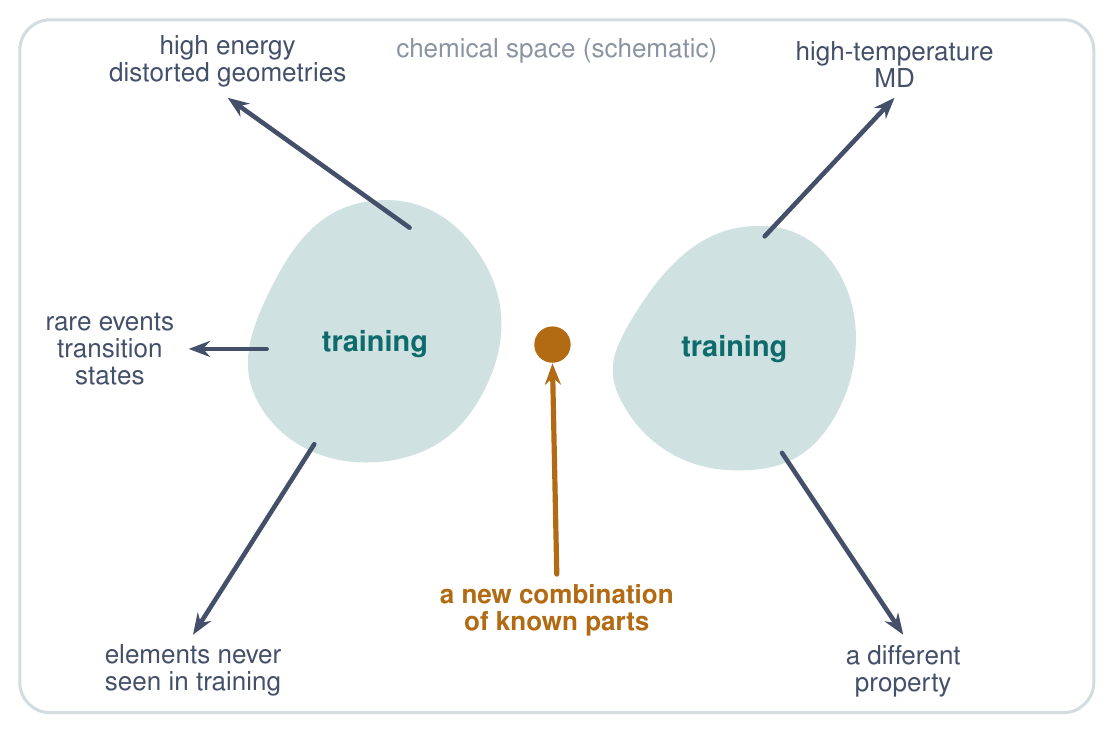
- Random splits of MD trajectories: test frames are near-duplicates of training frames
- Shifts in conditions: high temperature, distorted geometries, rare events, unseen elements
- Scaffold splits exist for molecular property prediction, but not for potentials
Missing: a controlled shift in composition, where every part is seen and only the whole is new.
What would such a test look like for a potential?
The question
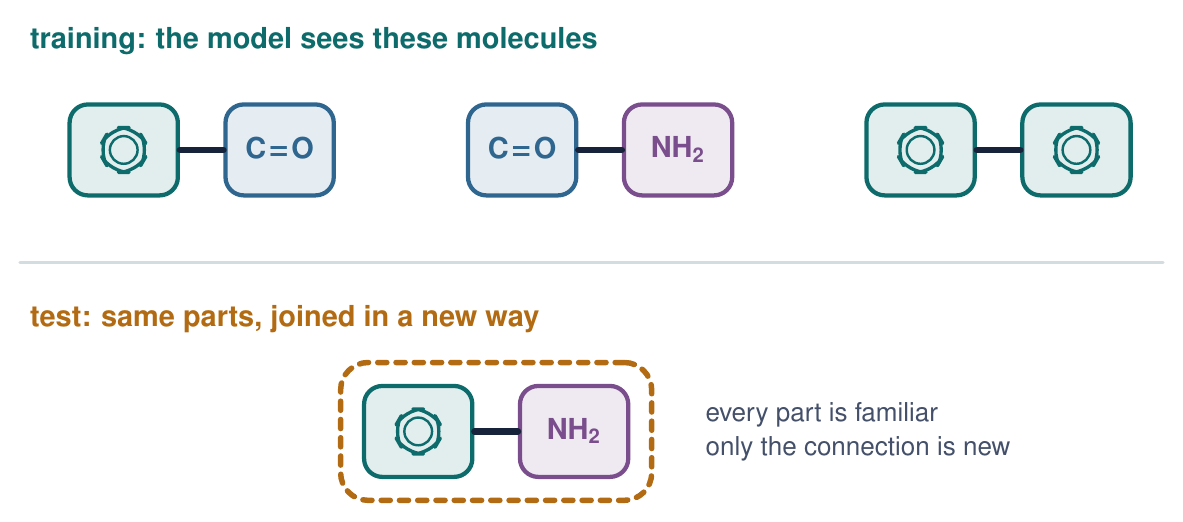
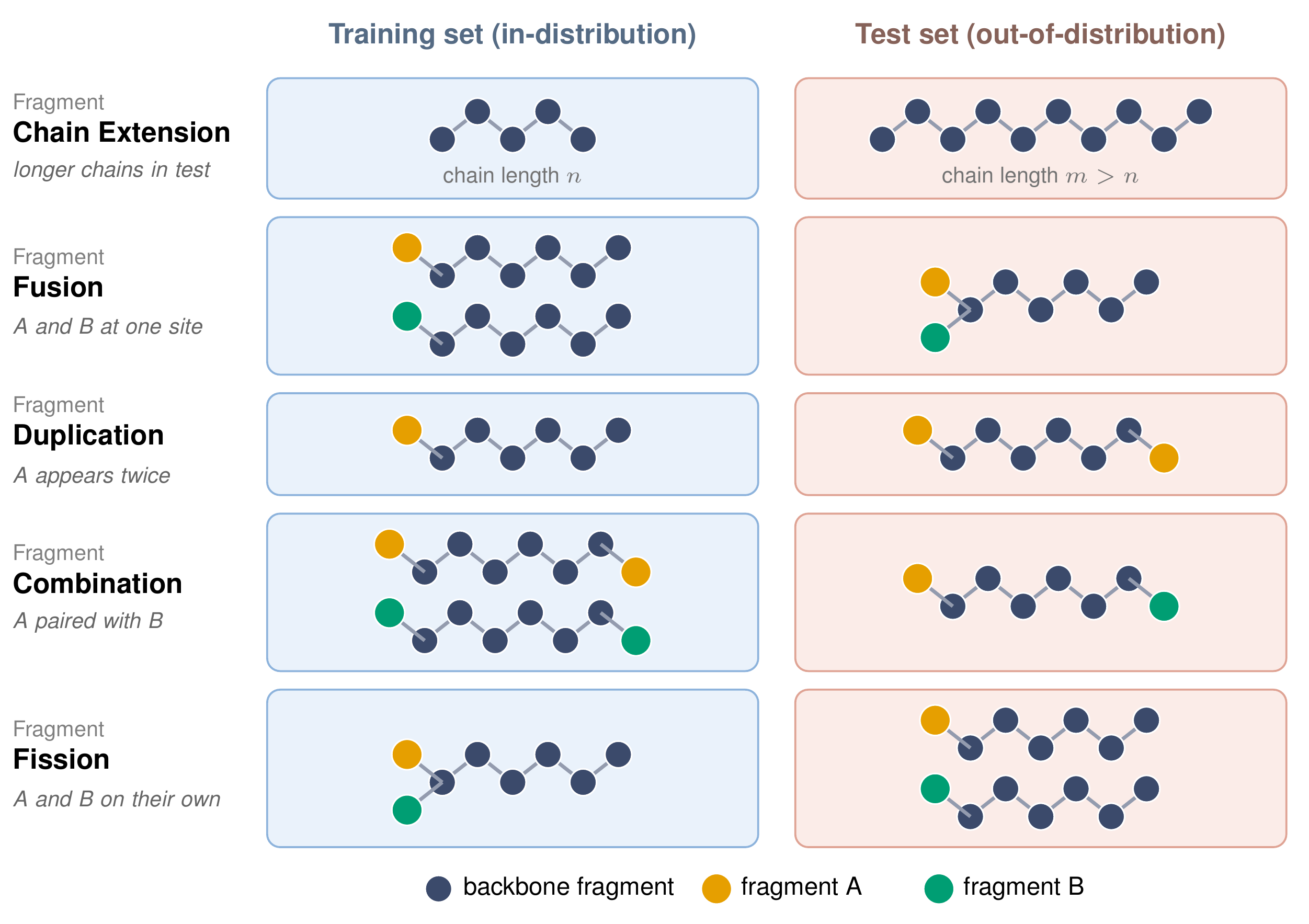
- Train on molecules built from fragments A, B and C
- Test on new molecules that join the same fragments in a new way
- A model that learned transferable local chemistry should find this easy
Do MLIPs generalise compositionally, or do they memorise the molecules they were trained on?
To answer this cleanly, we built a benchmark for it.
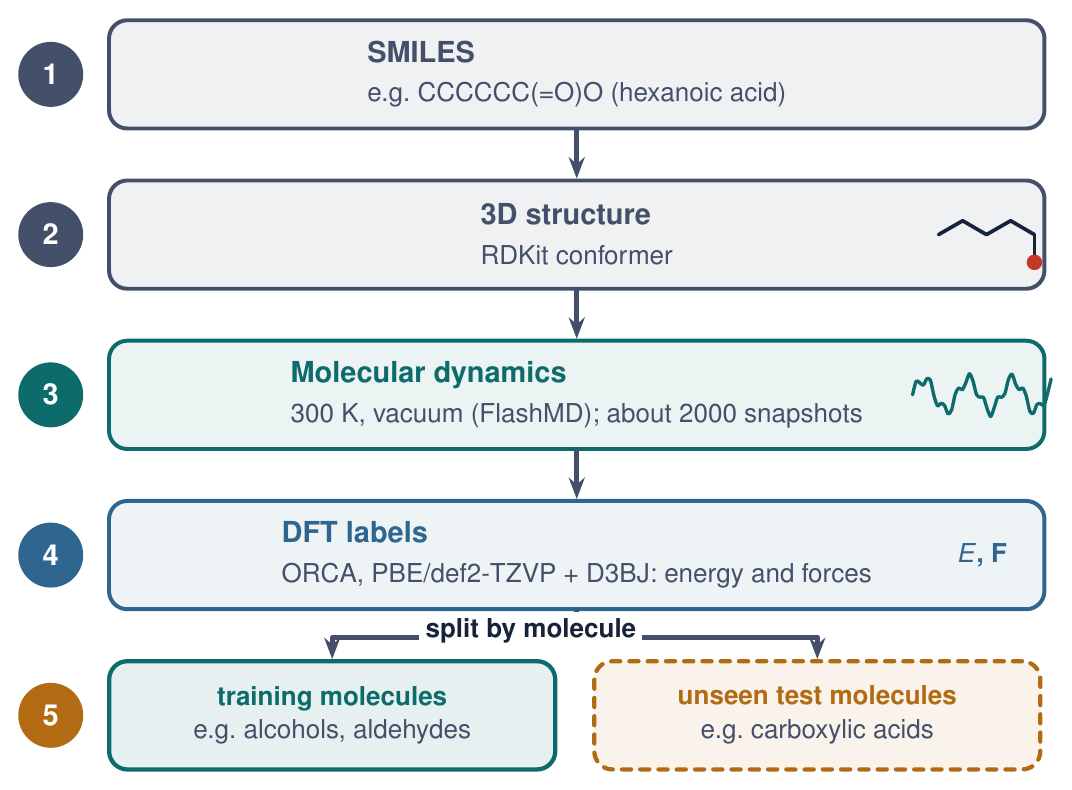
GMD: Generalisation for Molecular Dynamics
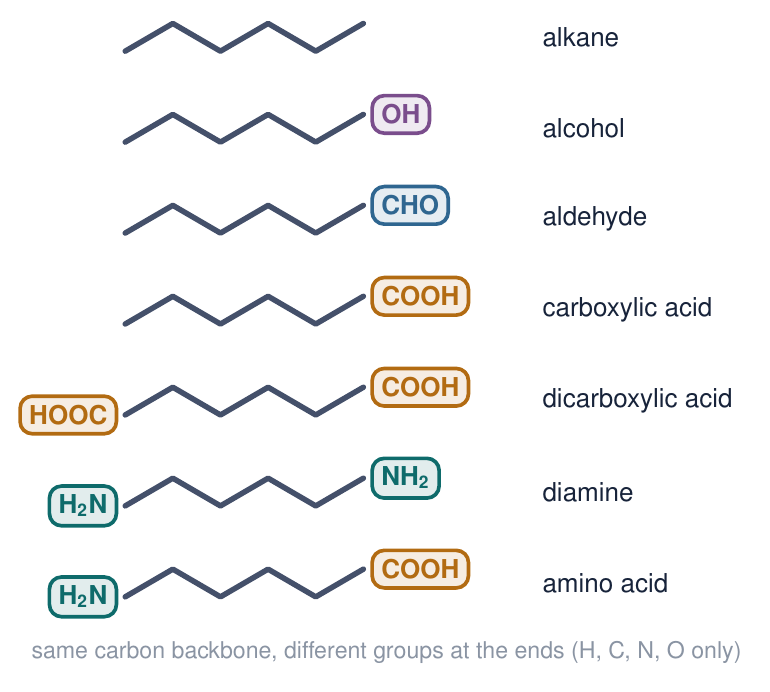
- 140 molecules in 12 families, built from H, C, N and O
- 300 K MD for each molecule, DFT energies and forces for every snapshot: about 280,000 labelled configurations
- Splits are by molecule, never by snapshot
Open data and code: huggingface.co/datasets/AmirMasoud/GMD
Which compositional operations do we test?
Five compositional operations
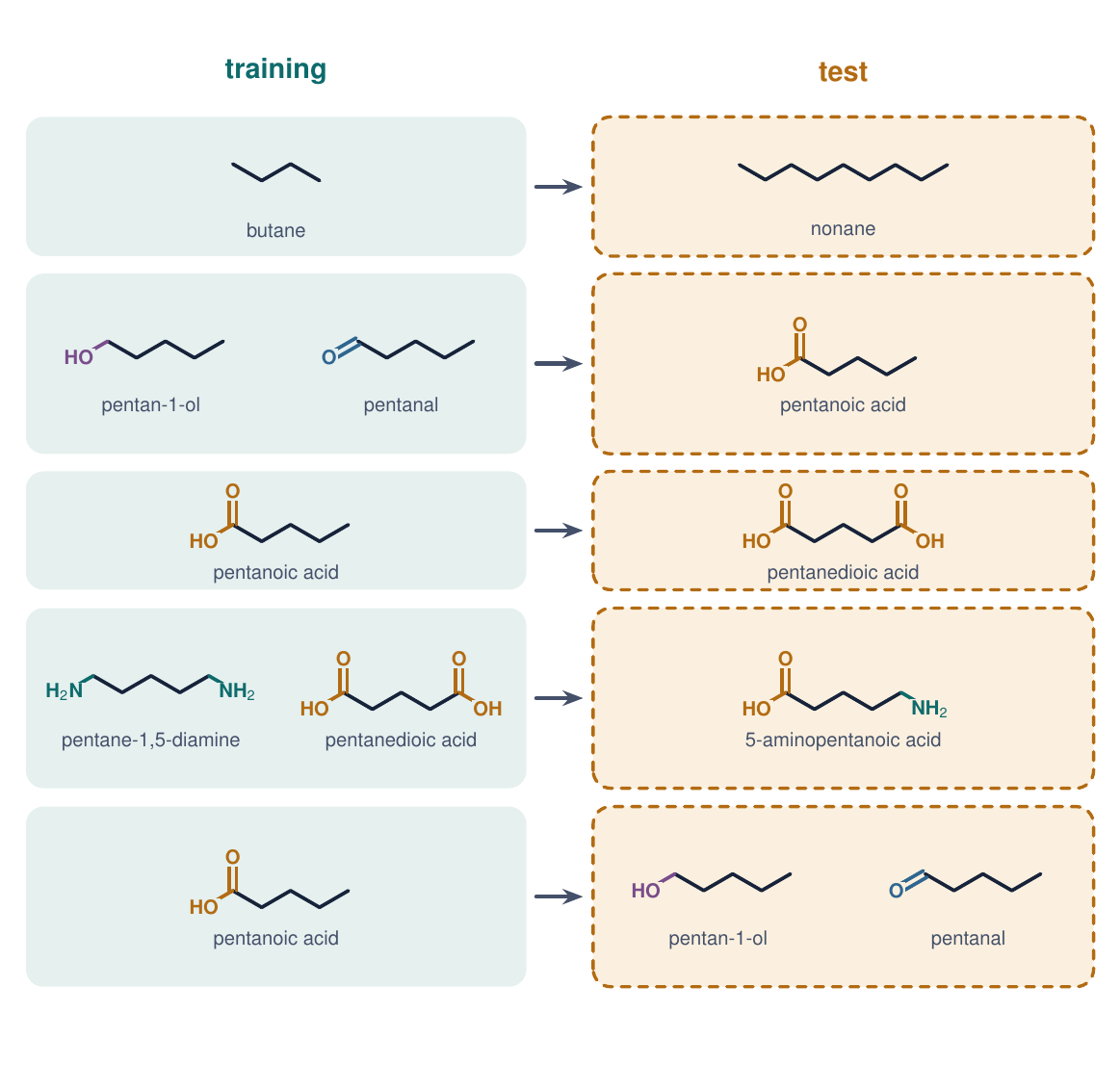
Why such small molecules?
Design choices
- One operation per task: a failure has one cause
- Minimal shift: failing the smallest step is a strong negative result
- Consistent labels: one DFT level, cheap enough for many models
- Controls: augmented training sets and GFN2-xTB labels
Which models did we put through this?
Known molecules versus new molecules
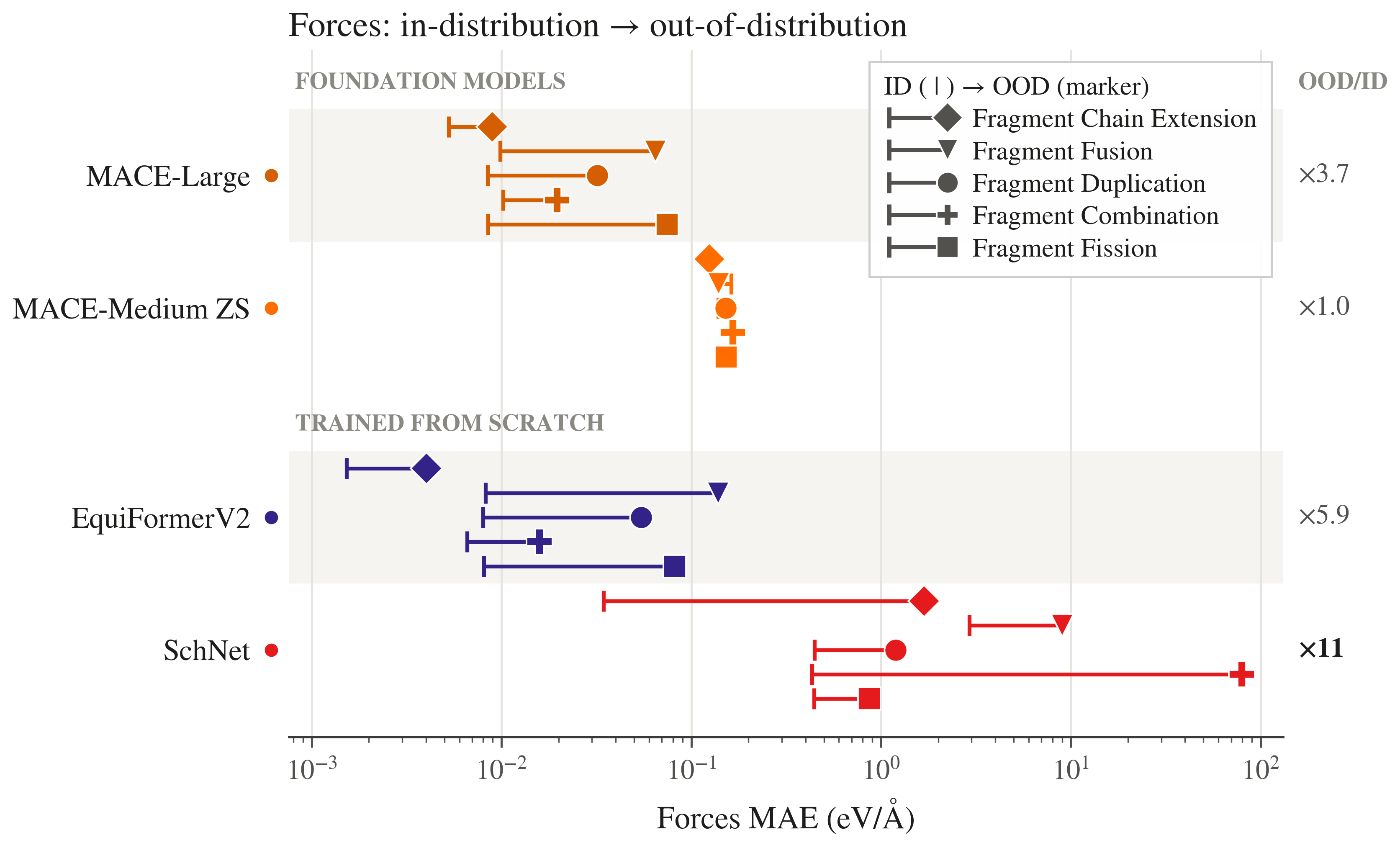
Where inside a molecule does the error appear?
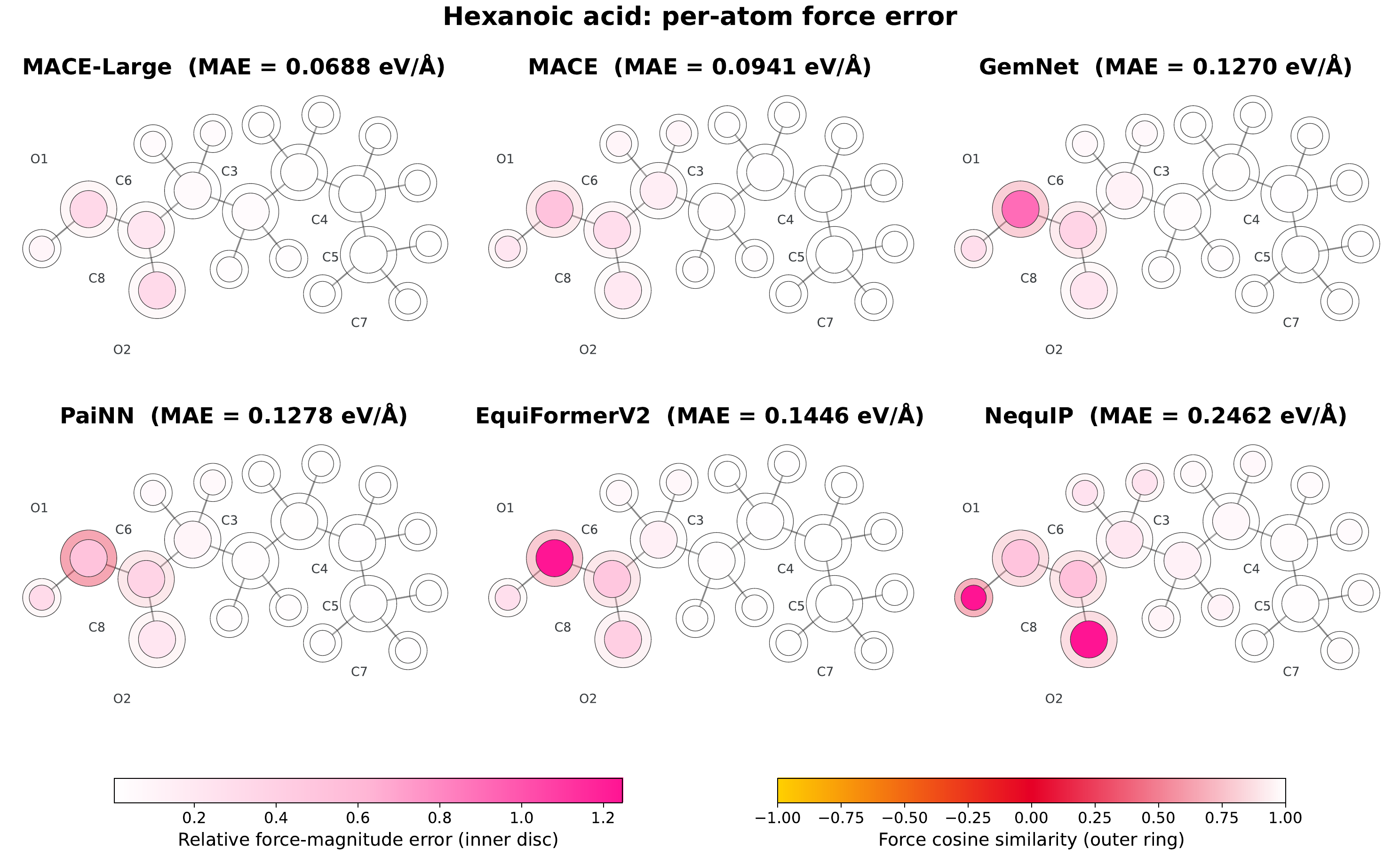
The error localises on the new composition
- Hexanoic acid, OOD in fusion: trained on alcohols and aldehydes
- Inner disc: force-magnitude error; ring: direction error
- Backbone is fine; error sits on –COOH, and it is mostly magnitude
Known: –OH and C=O. Not composed: –COOH.
Is length generalisation any easier than composition?
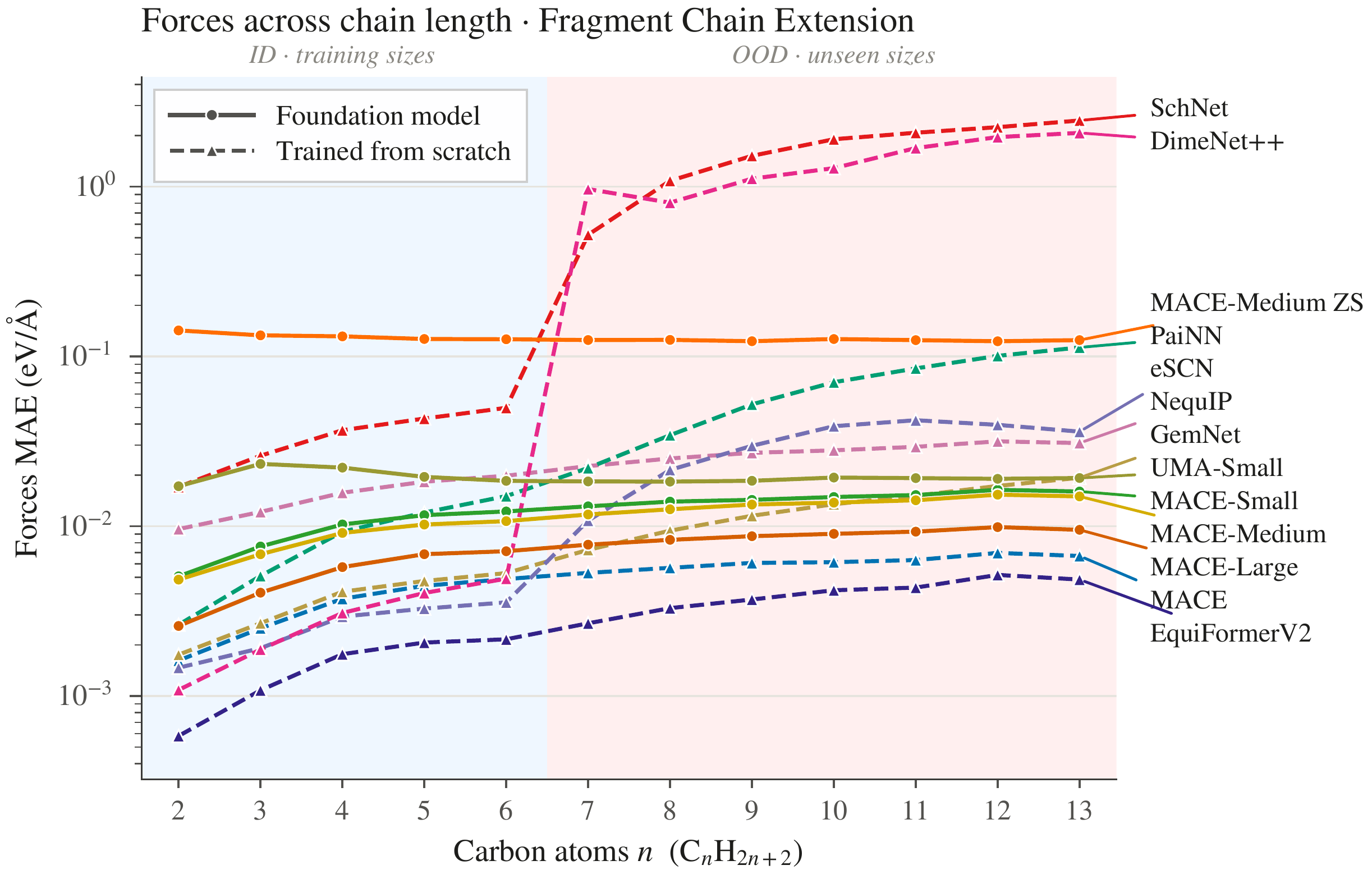
Chain extension: length generalisation is easier
- Train on C2 to C6 alkanes; test on C7 to C13
- Errors still rise with length, but far less than in the compositional tasks
- SchNet and DimeNet++ break down past the training lengths
Repeating a known part costs some accuracy. Composing parts in a new way costs far more.
Could more data, bigger models or pre-training close the gap?
Thank you
Amir Masoud Nourollah
Paper: arXiv:2605.08988 (NeurIPS 2026)
Data: huggingface.co/datasets/AmirMasoud/GMD
Code: github.com/Nourollah/GMD-26
Questions?